Blog 10
Wellbeing as strategic KPI

Wellbeing as a Strategic KPI
A world in transition
The 21st century is defined by a convergence of crises and transformations. Climate change is leading to widespread eco-anxiety, particularly among younger generations. At the same time, societal polarisation is increasing. In 2024, a record 56 active conflicts were recorded worldwide, the highest number since the Second World War. Due to social fragmentation, people increasingly feel isolated and lonely, undermining a sense of community and connection.
In this context, work is no longer viewed solely as an economic engine, but increasingly as a social and existential foundation. Human wellbeing – mental, physical and social – is becoming central in response to broader shifts in worldviews, values and expectations.
Why this trend is emerging
While technological progress has freed us from many physical constraints at work, it has not relieved psychological burdens. New forms of work such as hybrid working have become the norm. More than half of employees now work at least partly remotely. At the same time, employees are experiencing stress and burnout on an unprecedented scale.
Recent research shows that more than half of employees experience symptoms of burnout. In some cases, as many as two-thirds of respondents report burnout-related complaints. Younger generations are particularly vulnerable: among those aged 18–34, around 80% report feeling burned out.
This burnout epidemic illustrates that traditional labour models – largely focused on efficiency, profit maximisation and quantitative targets – fall short when it comes to protecting the human being.
At the same time, there is a growing demand for meaning in work. Whereas employees previously prioritised stability and income, they increasingly want their work to align with who they are and who they aspire to become.
A Gallup poll shows that nearly half of employees (45%) say they mainly work “for the paycheck”, rather than as a source of meaning. Only 18% experience their current job as work with a personally meaningful purpose. There is a clear gap between the meaning people derive from their work and what they actually desire.
This explains why trends such as “quiet quitting” (mental disengagement) and the Great Resignation have emerged: employees no longer accept work that offers no fulfilment or meaning. The rise of the trend “Wellbeing as a Strategic KPI” is a response to all these factors. It reflects a collective need for work that aligns with the human values and needs of our time.
How many organisations already steer on wellbeing as a KPI?
Clear global figures on “wellbeing as a strategic KPI” are still scarce, as organisations use different definitions and do not always label it explicitly as a KPI. Nevertheless, recent research shows a clear acceleration towards strategic embedding. In the latest CIPD Health & Wellbeing at Work report (2025), 57% of organisations already have a dedicated wellbeing strategy, and 74% say employee wellbeing is on the agenda of senior leadership. Among large employers, the shift towards measurability is also evident: in a 2025 survey of 131 large employers, 93% stated they are maintaining or expanding wellbeing investments, while 94% place greater emphasis on demonstrable outcomes through measurable parameters and dashboards. At the same time, wellbeing is increasingly moving into the domain of formal reporting. ESG reporting is now largely standard among large organisations, and European frameworks such as CSRD/ESRS further increase the pressure to explicitly define goals and metrics related to employee wellbeing.
What does a wellbeing focus require from organisations?
If wellbeing is to become a strategic key performance indicator, it requires a fundamental reorientation of how organisations are led and designed. It calls for leadership that not only directs, but above all listens.
Traditional command-and-control styles are counterproductive. Studies show that authoritarian leadership approaches undermine psychological safety, while supportive and consultative leadership styles – in which leaders seek employee input and grant autonomy – foster a safe, high-performing team culture. In other words: a shift from control to trust.
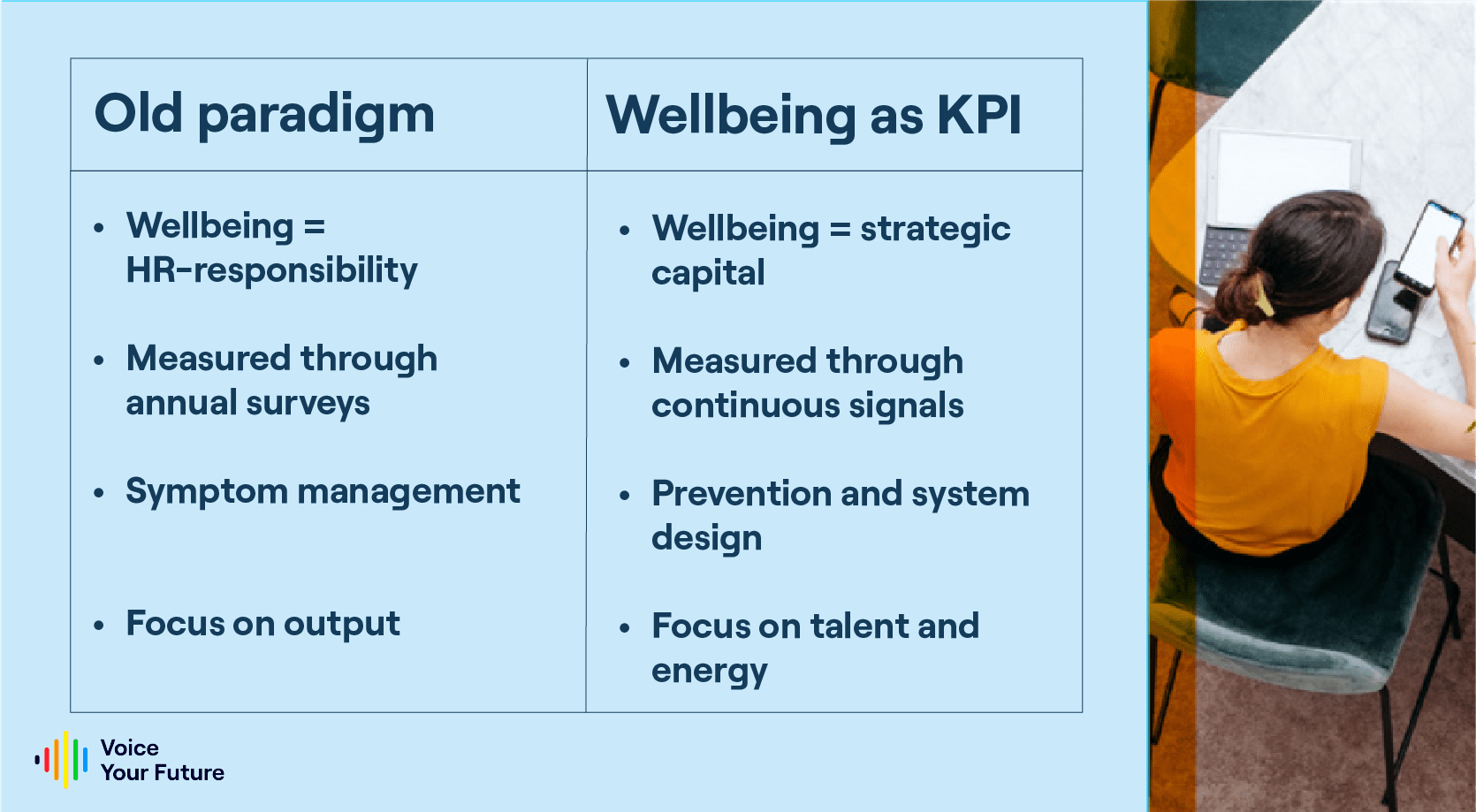
Organisational systems must also adapt: measurement alone is not enough. Instruments such as annual surveys fall short when they fail to capture the human experience behind the numbers. It is far more effective to regularly and genuinely take the pulse of employees. Research shows that although 70% of companies introduce wellbeing programmes, only 35% of employees experience any real improvement in their day-to-day work experience. This signals that the issue is not about ticking boxes, but about creating tangible impact. Organisations therefore need to look beyond surface-level metrics and gain deeper insight into the human experience.
Humanisation through technology
Technology should no longer serve automation alone, but humanisation. Digital tools and AI can be used to better understand and support people, rather than merely pursuing efficiency. The challenge lies in connecting automation with empathy and human connection.
This means that employee data analysis should not focus solely on productivity, but also on wellbeing indicators. More and more organisations are therefore integrating values such as autonomy, trust, psychological safety and personal growth into their policies, culture and technology.
Key areas of attention for organisations include:
- Autonomy and trust: Give employees room and responsibility. People perform better when they have control over how they work and when they feel trusted by their leaders.
- Psychological safety: Create an environment where everyone feels safe to voice concerns, admit mistakes and share ideas without fear of repercussions. Teams with high levels of psychological safety are more innovative and resilient.
- Personal growth: Facilitate development and purpose. Offer opportunities for learning, coaching and career path development aligned with individual values. Work becomes more meaningful when people are able to grow and contribute to something larger than themselves.
- Human-centred technology: Implement systems and tools (e.g. pulse surveys, wellbeing apps and AI analyses) that provide real-time insight into employee experience and development needs. Crucially, technology must be used to drive action – from workload adjustments to targeted support – not merely for registration.
- Listening culture and meaningful dialogue: Ensure employees feel consistently seen and heard. This requires an organisational culture in which conversations about energy, workload and development are normalised, with recurring one-on-one conversations, neutral conversation starters, attention to team building and safe reflection moments that allow space for real experiences, not just measurable output.
Work as a source of meaning
Ultimately, this trend raises a fundamental question: what does it mean to be human in a world of work? Philosophers such as Hannah Arendt have offered useful frameworks here. Arendt distinguished three forms of active human life: labour (labor) to sustain life, work to create something durable, and action to freely initiate something radically new. Especially this last category – collective action and meaning-making – is, according to Arendt, the highest form of human activity, in which freedom and identity are fully expressed.
Applying Arendt’s insight to the modern workplace reveals where contemporary work culture has fallen short. For years, the emphasis was on labour and work in the sense of efficient production, hitting targets and generating ever more output. The human dimension – action in the Arendtian sense, where people build together, exchange ideas and experience meaning – was sidelined. In 2026, the ideal workplace is a space for encounter, expression and collective creation. Work once again becomes a source of meaning: not merely a means of survival or production, but a fundamental part of personal fulfilment and identity development.
Towards a human-centred work culture
The trend “Wellbeing as a Strategic KPI” is not a fashionable management buzzword, but a signal of a deeper societal shift. We are at a tipping point where organisations recognise that performance is created by people, not at the expense of people. Reports clearly show that employee wellbeing is directly linked to business success: burnout, disengagement and quiet quitting cost companies billions each year, while investing in wellbeing is key to reversing this trend. Healthy, engaged employees are more productive – research suggests up to 20% more productive than unhealthy colleagues – and more innovative and loyal. In other words, human-centred work also makes economic sense. It is no coincidence that 95% of organisations that actively measure wellbeing report a positive ROI, with nearly two-thirds achieving at least a 2.5x return on investment.
This trend calls for a cultural shift that can be summarised as a move from control to trust, from performance to flourishing, and from symptom management to systemic change. It is an invitation to make work radically more human.
When wellbeing becomes a hard management parameter, decisions and strategies are tested against a simple question: does this contribute to human flourishing within our organisation? Leading organisations embrace flexible work, prioritise mental health and connect daily tasks to a higher purpose or societal contribution. These organisations demonstrate that technology can help us become more human – not less. Automation and AI then serve as tools to remove burdensome work and detect signals early, enabling people to apply their uniquely human qualities: creativity, empathy and meaning-making.
Conclusion: the role of wellbeing as a strategic KPI in 2026
In short, wellbeing as a strategic KPI is not an end in itself, but a signpost. It points the way towards a new work culture in which performance and human values go hand in hand. A culture in which work aligns with life, and employees feel seen and supported to give their best. Organisations that embrace this vision not only build more resilient and productive teams, but also contribute to a healthier society as a whole.
Technology as a mirror: how Voice Your Future supports organisations
To make wellbeing a strategic pillar, organisations must be willing to look honestly in the mirror. Voice Your Future facilitates this through voice assessments and an AI coach – an innovative approach that makes employee wellbeing tangible and measurable.
The human voice carries unique information about personality, energy, skills, development potential and balance. Through fast, validated voice analysis, personal patterns become visible. Not to measure the employee, but to better understand the human being behind the work.
These insights help organisations steer careers, roles and collaboration not only based on job profiles or expectations, but above all on where people truly thrive. Wellbeing then becomes not a separate programme, but a natural outcome of work that fits the individual: an environment in which people can grow, contribute and flourish.
Would you like to explore how your organisation can place greater strategic focus on wellbeing? Contact us at info@voiceyourfuture.com or visit www.voiceyourfuture.com
*) the list of sources used is available upon request via info@voiceyourfuture.com

