Enterpreneurship
Entrepreneurship starts before business ownership.
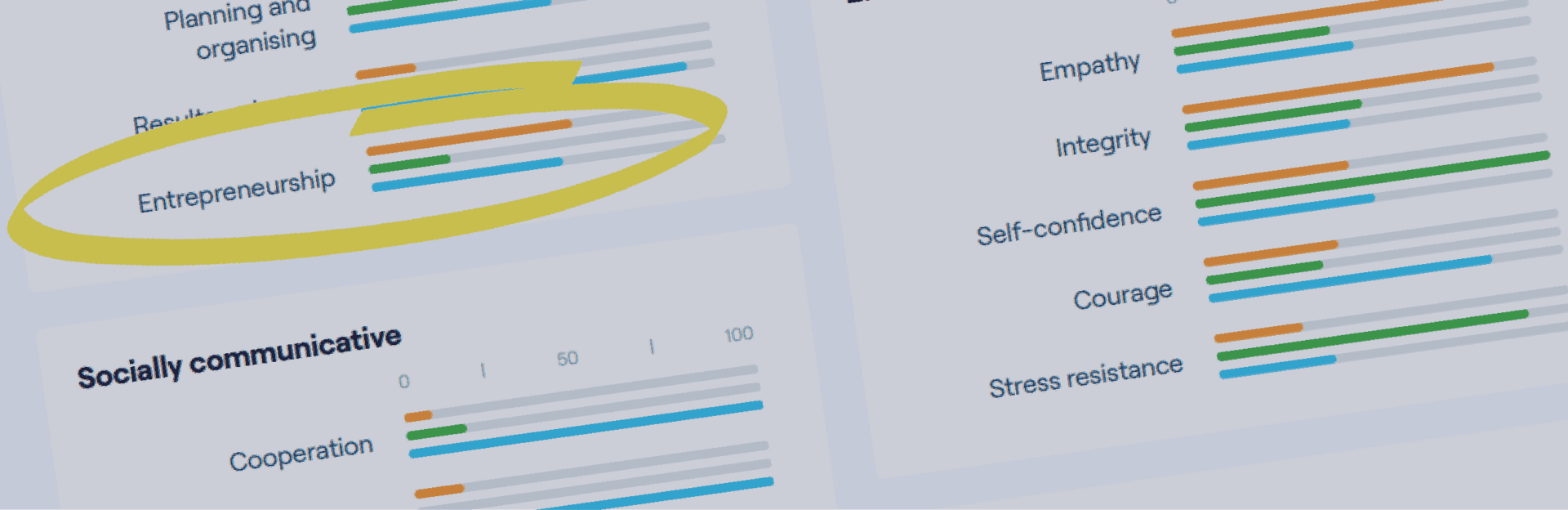
Entrepreneurship is much more than starting your own business. It is a behavioural competency that becomes visible in how someone recognises opportunities, takes initiative, turns ideas into action and creates value for others. That is precisely why entrepreneurial behaviour is so valuable, both within and outside organisations.
Mark has worked for the same organisation for twelve years. He does not own a business, he is not a manager and he does not have a commercial role. Yet he is the person who constantly spots opportunities. He notices where processes could be smarter, identifies customer needs before they are expressed and regularly comes up with ideas to improve products or working methods. Nobody asks him to do this. He does it because he sees possibilities.
On the other side of the office works Sophie. She rarely comes up with big, groundbreaking ideas, but once a plan exists, she is the person who makes sure it actually happens. She brings the right people together, monitors progress, resolves bottlenecks and ensures that a good idea does not get stuck in a PowerPoint presentation, but actually becomes part of daily practice.
Which of these two demonstrates entrepreneurial behaviour?
Many people will instinctively point to Mark. After all, he fits the stereotypical image of an entrepreneur: innovative, creative and always looking for new opportunities.
Yet that answer is incomplete.
Sophie is entrepreneurial too. Perhaps just as entrepreneurial as Mark, only in a different way.
We often confuse entrepreneurship with being an entrepreneur. As if entrepreneurship only consists of starting a company or developing new products. Research presents a much richer picture of what entrepreneurship actually is.
Entrepreneurship is first and foremost not a profession or a job title. It is a behavioural competency. A way of seeing, thinking and acting that enables people to recognise opportunities, take initiative and create value, regardless of the role they perform.
At Voice Your Future, we see every day that people who score highly on the entrepreneurship competency are by no means always self-employed entrepreneurs. They may just as easily work in healthcare, education, engineering, government or business. Some constantly open new doors. Others make sure innovation is actually implemented. Both forms are equally valuable.
When people hear the word entrepreneurship, they usually think of owning a business. Of entrepreneurs who invest, take risks and enter new markets. That image is understandable, but from a scientific perspective it is too limited.
The European Commission defines entrepreneurship in the EntreComp framework (Bacigalupo et al., 2016) as the ability to turn opportunities and ideas into value for others. That value does not necessarily have to be financial. It can just as easily be social, organisational or societal. According to this definition, someone who improves a process so that colleagues can work more efficiently is acting just as entrepreneurially as someone who starts a company.
This broader definition aligns with modern scientific research into entrepreneurial behaviour. Researchers increasingly refer to entrepreneurial competence or intrapreneurship: entrepreneurial behaviour by people within existing organisations. The focus is not on owning a business, but on the ability to recognise opportunities, take initiative, deal with uncertainty and actually turn ideas into results.
This makes entrepreneurship a universal competency. You can see it in nurses who develop a new working method, teachers who innovate their teaching, engineers who design a smarter production process and leaders who identify new market opportunities. Even within voluntary organisations, there are people who constantly see opportunities to organise activities more effectively or involve more people.
Entrepreneurship is therefore not primarily about an enterprise. It is about behaviour in which the entrepreneurship competency becomes visible.
Although research describes entrepreneurial behaviour as one broad behavioural competency, it also shows that this competency does not manifest in the same way in everyone. The way entrepreneurship becomes visible depends not only on the person, but also on the role they perform and the context in which they work.
In this article, we therefore present two recognisable expressions of entrepreneurial behaviour. We call them the Builder and the Implementer. Not as official types or fixed categories, but as a practical way to show that the same competency can have different emphases.
It is important to emphasise that we do not introduce the Builder and the Implementer here as personality types or categories. They represent two different, recognisable emphases within entrepreneurial behaviour. The same person may primarily show the Builder in one situation and more of the Implementer in another context.
The Builder represents the behaviour people often associate first with entrepreneurship: spotting opportunities, thinking ahead, exploring new directions and creating momentum. They think ahead, make unexpected connections, identify developments in their environment and dare to open up new possibilities. For the Builder, change is not a threat, but an opportunity.
The Implementer shows that the entrepreneurship competency is broader than this first, visible image. Not by constantly coming up with new ideas, but by making sure that good ideas actually become reality.
This approach aligns well with the Trait Activation Theory of Tett and Burnett (2003). This theory states that personality traits and behavioural tendencies are not equally visible in every situation. The environment plays an important role. An organisation that provides room for experimentation, initiative and autonomy activates different entrepreneurial behaviour from an organisation in which procedures, control and risk reduction are central.
The Person-Environment Fit approach, developed among others by Kristof (1996) and later further supported by Kristof-Brown, Zimmerman and Johnson (2005), also offers an explanation. This approach shows that behaviour comes into its own when there is a good match between the person and the work environment. Someone with strong entrepreneurial capacity is more likely to demonstrate that competency when the role and organisation genuinely provide room for it.
The Builder and the Implementer are therefore not labels, but a way of showing that entrepreneurship can take different forms and always arises through the interaction between person, role and context. This is precisely why organisations need both. One opens up new possibilities, while the other ensures those possibilities are actually realised. Both demonstrate characteristics of the Entrepreneurship competency, but in different ways.
The word entrepreneurship is often used as if it were a profession. “You are an entrepreneur or you are not.” In practice, it works differently.
Entrepreneurship is not a role. A director may show little entrepreneurial behaviour, while an employee without leadership responsibility may constantly take initiative and achieve improvements.
Nor is it simply a single skill. Skills such as creative thinking, planning or collaboration certainly contribute, but none of those skills on its own describes what entrepreneurship really is.
Entrepreneurship is a behavioural competency. It is an interconnected combination of knowledge, skills, motivation and behaviour that becomes visible in how someone recognises opportunities, takes responsibility, deals with uncertainty and creates new value.
This makes entrepreneurship fundamentally different from creativity, for example. Creativity is about generating new ideas. Entrepreneurship only begins when someone decides to do something with those ideas.
Taking initiative alone is not enough either. Entrepreneurship means not only starting, but also persevering, learning, adjusting and ultimately realising something that adds lasting value.
This may make entrepreneurship one of the most integrated behavioural competencies there is. It relates to creativity, decisiveness, collaboration, perseverance, learning ability, leadership and the ability to drive change, but it is not identical to any of these competencies.
Over the past twenty years, scientific interest in entrepreneurial behaviour has increased significantly. Remarkably, this research focuses less and less on entrepreneurs as an occupational group and increasingly on entrepreneurial behaviour within existing organisations.
The most important international foundation for this is the EntreComp framework developed by the European Commission’s Joint Research Centre (2016). This model describes entrepreneurship as a competency that everyone can develop and distinguishes fifteen underlying elements across three areas: spotting opportunities, mobilising resources and taking action. Together, they form a broad and scientifically grounded framework for entrepreneurial behaviour.
In addition to EntreComp, the Proactive Motivation Model by Parker, Bindl and Strauss (2010) forms a second important foundation. This model shows that proactive and entrepreneurial behaviour emerges when people experience three conditions. They must believe they can make a difference (can do), have a clear reason to act (reason to) and experience sufficient energy to actually take initiative (energized to). If one of these conditions is missing, entrepreneurial behaviour often decreases, even among people who naturally have an aptitude for it.
A third important research stream is Personal Initiative (Frese & Fay, 2001). Here, entrepreneurial behaviour is described as self-starting, future-oriented and focused on overcoming obstacles. Entrepreneurial people do not wait for someone else to solve a problem. They take the first step themselves and continue to act when the situation is uncertain.
Finally, the concept of Job Crafting, introduced by Wrzesniewski and Dutton (2001), shows that employees can actively shape their work. They seek improvements, build new collaborations and create opportunities themselves to add more value. Later studies show that this is associated with greater engagement, higher job satisfaction and better performance, provided that the organisation offers sufficient room for initiative (Tims et al., 2012; Rudolph et al., 2017).
Despite their different perspectives, these scientific models have a remarkable amount in common. The same core elements appear repeatedly:
Voice Your Future makes this broad behavioural competency visible under the Entrepreneurship competency.
Entrepreneurial behaviour influences much more than innovation alone. It affects virtually every level at which organisations operate.
For individual employees, entrepreneurial behaviour often means greater ownership, more autonomy and a stronger sense of meaning.
Within teams, entrepreneurial behaviour helps improvements to be adopted faster, knowledge to be shared more easily and problems to be solved sooner.
For organisations, the need is growing for employees who recognise opportunities, take responsibility and help make change happen.
For the individual employee, entrepreneurial behaviour often means greater ownership, more autonomy and a stronger sense of meaning. People experience that they can genuinely influence their work and see that their efforts make a difference. This generally increases engagement and job satisfaction, provided that the organisation offers room to take initiative.
Within teams, entrepreneurial behaviour helps improvements to be adopted faster, knowledge to be shared more easily and problems to be solved sooner. Teams in which employees dare to take initiative appear better able to adapt to changing circumstances.
The value is also significant for organisations. Modern organisations operate in an environment where technology, customer needs and markets are constantly changing. As a result, the need is growing for employees who do not wait, but recognise opportunities, take responsibility and help make change happen.
In scientific literature, this is often referred to as intrapreneurship. Literally, it means entrepreneurship within an existing organisation. An intrapreneur is not an entrepreneur with their own business, but an employee who behaves entrepreneurially. They recognise opportunities, take initiative, experiment, connect people and create new value while working within an existing organisation.
In many modern organisations, these intrapreneurs are the driving force behind innovation, process improvement and organisational development. Research shows that entrepreneurial behaviour within organisations is associated with better performance, greater innovation and a stronger ability to actually implement change. Entrepreneurship is therefore relevant not only to founders or executive teams, but also to professionals, teams and leaders.
At the same time, research shows that entrepreneurial behaviour does not emerge automatically. Autonomy, psychological safety, support from leaders and a suitable work environment largely determine whether this competency actually becomes visible. We return to this in more detail later in this article.
Entrepreneurship is still associated with visibility in many organisations. The employee who enthusiastically presents new ideas, spots opportunities before others notice them and easily inspires colleagues is quickly labelled “entrepreneurial”. That image is understandable. Innovation often begins with an idea. Yet this tells only part of the story.
In practice, organisations regularly assess entrepreneurial behaviour based on how visibly someone demonstrates it rather than on what they actually set in motion. As a result, the people who initiate change receive the most attention, while those who enable change or embed it sustainably are much less visible.
This is remarkable because, scientifically, entrepreneurship is not only about discovering new possibilities. The European Commission defines entrepreneurship as the ability to turn opportunities and ideas into value for others. That definition may begin with an idea, but it is only complete when the idea has actually created value. It is precisely this second part that is often underestimated in practice.
Consider, for example, an employee who develops an innovative digital system that enables customers to receive faster service. The idea is innovative and attracts considerable attention. But without the colleagues who test the system, adapt processes, train users, address resistance and ensure that everyone starts using it, the same innovation remains a good plan on paper.
Entrepreneurship therefore involves more than opening new doors. It also requires the ability to bring people along, overcome obstacles and embed change sustainably.
This is precisely why the entrepreneurship competency is so much broader than creativity alone. Creativity helps generate new possibilities. Entrepreneurship truly begins when someone decides to take responsibility for a possibility and turn it step by step into something that actually makes a difference.
This also explains why organisations sometimes reward the wrong people. The most visible employee is not automatically the person making the greatest contribution to innovation. Nor is the quietest colleague automatically less entrepreneurial. Entrepreneurship cannot be assessed by appearance, but by behaviour and by the value that behaviour ultimately creates.
As described in the previous section, entrepreneurial behaviour takes different forms. In this article we therefore use the images of the Builder and the Implementer. Not as personality types or official categories, but as a practical way to show that the same competency can have different emphases.
Both forms are essential.
In fact, the most successful organisations are rarely dependent on one exceptionally entrepreneurial individual. They create teams in which Builders and Implementers reinforce one another. One drives innovation, the other continuity. One opens new possibilities, the other ensures those possibilities create lasting value.
It is precisely this interaction that makes entrepreneurship one of the most versatile behavioural competencies within organisations.
The term intrapreneur was introduced as early as 1985 by American entrepreneur and management consultant Gifford Pinchot. He used the term for employees who behave like entrepreneurs within an existing organisation.
At the time, this was a remarkable idea. Entrepreneurship was almost exclusively associated with people who owned their own businesses. Pinchot (1985) reversed that perspective. According to him, someone does not need to own a business at all to demonstrate entrepreneurial behaviour. In fact, many of the most important innovations emerge within existing organisations because employees recognise opportunities, take initiative and feel responsible for actually implementing improvements.
He called these employees intrapreneurs.
An intrapreneur is therefore not an entrepreneur with their own business, but a professional who behaves entrepreneurially within their organisation. They recognise opportunities, dare to question existing working methods, experiment with new solutions and take responsibility for turning ideas into concrete results.
Since Pinchot introduced the concept, it has developed into a fully established field of research within organisational studies. Modern scientific models, such as the European EntreComp framework (2016), align seamlessly with this idea. Here too, the focus is not on owning a business, but on the ability to recognise opportunities, take initiative and create value, regardless of someone’s role or the organisation in which they work.
For many Voice Your Future participants, this is an important insight. A high score on the Entrepreneurship competency does not automatically mean that someone should start their own business. More often, such a profile shows that someone has the potential to make an important contribution to innovation, improvement and development within an existing organisation as an intrapreneur.
Entrepreneurial behaviour does not look the same in every situation.
Sometimes entrepreneurship begins with initiative: someone spots an opportunity, experiments and improves their own work or immediate environment.
Sometimes entrepreneurship requires collaboration: ideas need to be organised, people connected and change implemented step by step.
And sometimes entrepreneurship requires direction: looking ahead, recognising new possibilities and creating the conditions that enable an entire organisation to innovate.
The fact that entrepreneurial behaviour takes different forms does not mean that every form of entrepreneurship has the same influence. As responsibility increases and influence extends across more people, processes or organisational levels, the way the entrepreneurship competency becomes visible also changes.
In the Netherlands, The Art of Management by Marcel A. Nieuwenhuis (2010) is one of the established reference works in competency-based practice. For the Entrepreneurship competency, Nieuwenhuis distinguishes three levels of development: operational, tactical and strategic.
At first glance, this may appear to be primarily a practical classification. However, when looking at the scientific literature, something striking emerges. The same three-part development can be found implicitly in many modern studies of entrepreneurial behaviour. Not because researchers use the same terminology, but because they describe the same development: entrepreneurship often begins close to someone’s own work, then expands towards collaboration and organisational development, and can ultimately result in shaping the strategic direction of an organisation.
These three levels do not form a hierarchy in which strategic entrepreneurship is automatically better than operational entrepreneurship. They mainly show that entrepreneurial behaviour changes as the context becomes larger, more complex and less predictable.
After all, every organisation needs people who identify opportunities every day as well as people who provide direction for the future. The levels therefore differ not in value, but in scope.
Central question
How can I improve my own work or immediate environment?
Recognising opportunities, taking initiative, experimenting and improving.
Central question
How can we turn opportunities into sustainable change together?
Connecting, organising, creating support and implementing.
Central question
How do we create lasting value for the future?
Providing direction, innovating, inspiring and creating the conditions for entrepreneurship.
The three cards provide an initial overview. Below, we explore each level in more detail, including the behaviour associated with it, potential pitfalls and how the Builder and the Implementer can manifest at each level.
For many people, entrepreneurship begins with spotting an opportunity that others have not yet noticed:
An employee notices that customers keep asking the same question. A nurse discovers that a small change in planning significantly reduces waiting times. A mechanic sees that a machine keeps breaking down in the same way and develops a simpler solution. A teacher notices that students learn better when a lesson is structured differently.
These may not be groundbreaking innovations, but they have one important characteristic in common: someone saw an opportunity and decided to act on it.
According to Nieuwenhuis, operational entrepreneurship is characterised by employees who are open to change, pick up signals from their environment and respond to the needs of customers, colleagues or the organisation. They do not wait for someone else to solve a problem, but take responsibility themselves for initiating improvements.
Scientifically, this closely aligns with what Parker, Bindl and Strauss (2010) describe as proactive behaviour. Entrepreneurial employees do not simply respond to events; they actively try to influence them positively. They act with the future in mind, anticipate developments and take the first step on their own initiative.
This does not require major investments or far-reaching changes. On the contrary, much operational entrepreneurship consists of small improvements that are realised day after day. This is where the greatest source of continuous improvement lies: with employees who recognise dozens of small opportunities every day.
Operationally entrepreneurial employees:
Although this behaviour often starts small, it forms the breeding ground for almost all larger innovations within organisations.
At operational level, the Builder stands out primarily through curiosity. They constantly wonder why things are done the way they are. Could this be faster? Smarter? More customer-friendly? Cheaper? More enjoyable?
The operational Builder enjoys experimenting because they believe things can always be improved. These are often employees who spontaneously come up with ideas, try new tools or get colleagues enthusiastic about a different way of working. Their strength lies in opening up possibilities.
The operational Implementer also sees opportunities, but immediately considers feasibility and support as well.
Implementers ensure that improvements are not temporary, but become a lasting part of the work. Where the Builder often takes the first step, the Implementer ensures that the next hundred steps are taken as well.
Like every competency, entrepreneurship also has a downside.
The operational Builder may develop so many ideas that colleagues struggle to keep up. Without sufficient focus, there is a risk that new initiatives continually emerge while earlier improvements have not yet been completed.
The operational Implementer faces a different risk. Because they devote considerable attention to careful execution and implementation, the emphasis may sometimes shift too far towards optimisation. As a result, new opportunities may be explored less quickly and there is a risk that the organisation mainly continues to improve existing processes without genuinely innovating.
This is precisely why the two emphases complement one another so well.
Imagine that a logistics employee notices that drivers lose a lot of time every day because delivery information is spread across different systems.
The Builder suggests bringing all information together in a single mobile application. They investigate existing solutions, talk to colleagues and create an initial prototype.
The Implementer then organises a pilot, gathers feedback from drivers, adapts the process, provides instructions and guides the implementation. A few months later, the entire organisation is working with the new approach.
Which of the two was entrepreneurial?
Both!
Without the Builder, the idea would probably never have emerged. Without the Implementer, it would probably never have become reality.
Where operational entrepreneurship mainly takes place within someone’s own work, tactical entrepreneurship shifts the focus towards teams, projects and organisational units.
The tactically entrepreneurial professional looks not only at their own work, but also at how a larger whole functions. New ideas must also be aligned with different interests, disciplines and departments. This changes the nature of entrepreneurship. Taking initiative remains important, but is joined by other competencies such as collaboration, influencing, organising, connecting and creating support.
According to Nieuwenhuis, tactical entrepreneurship is characterised by professionals who actively respond to developments, translate innovative initiatives into practical applications and propose creative solutions to improve existing working methods.
Scientific literature aligns well with this. Within the EntreComp framework, the focus at this level shifts from recognising opportunities towards mobilising resources and people. Entrepreneurship becomes less and less an individual activity and increasingly a social process in which collaboration, trust and shared ownership are central.
Tactically entrepreneurial professionals:
At this level, entrepreneurship becomes less and less an individual achievement and increasingly a shared challenge.
The tactical Builder looks beyond the boundaries of their own department. They identify developments in the market, within the organisation or in other professional fields and know how to connect them. This often leads to new projects, new collaborations or innovative services. The tactical Builder’s strength lies in making connections that others have not yet seen.
They ask questions such as:
This creates innovation that goes beyond a one-off improvement.
The tactical Implementer then focuses on making that innovation happen. They bring the right people together, organise meetings, make agreements, monitor schedules and ensure that responsibilities are clear. The Implementer gains energy from the moment when a project actually starts moving.
They understand that successful change rarely emerges from one good idea, but almost always from effective collaboration. The tactical Implementer is often the person who prevents enthusiasm from slowly fading after a project has started.
At tactical level, entrepreneurship also has its downside.
The tactical Builder may see so many new possibilities that priorities become blurred. The tactical Implementer, on the other hand, may devote so much attention to alignment and support that decision-making is unnecessarily delayed.
Again, the two emphases complement each other. Where the Builder creates momentum, the Implementer provides stability. Where the Builder provides direction for change, the Implementer ensures that the change is actually realised.
A municipality wants to digitalise its services.
A policy adviser notices that residents increasingly need online services and develops a vision for a digital customer portal. He researches developments in other municipalities, talks to residents and outlines a vision of the future.
A project leader then takes over. She brings together IT, communications, civil affairs and external suppliers, organises pilots, monitors planning and ensures that the new portal is actually put into use.
One built the direction. The other implemented the change. Together they made the organisation more entrepreneurial.
Strategic entrepreneurship is no longer about individual improvements or projects. At this level, the focus shifts towards the future of the organisation as a whole.
Strategic entrepreneurship means looking ahead, recognising opportunities before they become visible to everyone and making choices that strengthen the organisation in the long term. According to Nieuwenhuis, at this level we see people who initiate innovative activities, inspire others and actively build the future of the organisation.
Scientific literature also shows that entrepreneurship at strategic level increasingly moves away from individual initiatives and towards creating the conditions in which others can be entrepreneurial. The strategically entrepreneurial leader does not simply create opportunities personally, but builds an environment in which innovation becomes part of the organisational culture.
This also changes the role of the Builder and the Implementer.
The strategic Builder constantly looks outward. They follow societal developments, technological innovations and changing customer needs. Not to respond immediately to every trend, but to understand which opportunities are genuinely meaningful.
The strategic Builder asks questions such as:
Their strength lies in creating direction. Not every opportunity needs to be pursued, but without these people, new possibilities often fail to emerge in the first place.
The strategic Implementer focuses on building the organisation that can actually make this future a reality. They do not develop strategy merely to create an attractive document, but to ensure that employees, processes, resources and culture genuinely develop in the same direction.
The strategic Implementer asks questions such as:
This is how sustainable innovation emerges.
The strategic Builder runs the risk of continually seeing new opportunities, resulting in a lack of focus. When new directions are constantly chosen, unrest arises and employees no longer know what the organisation really stands for.
The strategic Implementer, on the other hand, may place too much emphasis on control and structure. Innovation may then be organised so carefully that little room remains for genuine experimentation.
Successful organisations know how to connect both perspectives here as well.
A healthcare organisation sees that an ageing population and staff shortages will increase significantly over the coming years.
The executive with a strong Builder emphasis sees not only a problem, but also an opportunity to organise care differently. He develops a vision centred on digital support, prevention and regional collaboration.
The executive with a strong Implementer emphasis then translates this vision into investments, training, change programmes and new forms of collaboration. He ensures that the strategy is not only ambitious, but also achievable.
Together, they are not only building a new strategy, but an organisation that is ready for the future.
Although operational, tactical and strategic entrepreneurship have different emphases, together they form one continuous development. They cannot be viewed separately. In fact, the strength of an organisation often lies precisely in the connection between these three levels.
Operational entrepreneurship ensures that opportunities are recognised. Employees identify improvements, experiment with new solutions and take the first step towards change.
Tactical entrepreneurship ensures that those ideas are organised. Teams are connected, support is created and initiatives develop into projects or new ways of working.
Strategic entrepreneurship then provides direction. It determines which developments matter for the organisation’s future and creates the conditions in which entrepreneurship can continue to grow.
An organisation in which one of these levels is missing becomes unbalanced.
An organisation without operational entrepreneurship misses the ideas and signals that emerge every day on the work floor. Problems are identified later, opportunities for improvement remain unused and innovation mainly comes from the top.
An organisation without tactical entrepreneurship often has many good ideas, but little lasting change. Initiatives fail because collaboration is lacking or because nobody takes responsibility for implementation.
And an organisation without strategic entrepreneurship risks constantly focusing on separate improvements without a clear direction or long-term vision. People work hard, but not always towards the same future.
The same applies to the Builder and the Implementer.
Both emphases are needed at every level. The Builder opens up new possibilities. The Implementer ensures that those possibilities actually become part of the organisation.
This is precisely why entrepreneurship is not an individual quality that exists separately from its environment. It is a competency that grows through collaboration with others.
After reading the previous sections, it would be easy to get the impression that entrepreneurship is mainly about taking more initiative, innovating more often or constantly creating new opportunities.
In reality, it is more nuanced. Entrepreneurial behaviour is not a trick that everyone can learn in the same way. It emerges from an interplay of talents, motivation, experience and the environment in which someone works.
This is precisely why two people with similar entrepreneurial capacity may behave completely differently in practice. One gains energy from pioneering. The other from implementing change. One constantly seeks new possibilities. The other gains satisfaction from improving existing processes.
Neither is better. They represent different emphases within the same competency. Self-awareness helps you understand where your natural strength lies and which behaviours can still be developed further.
This may make self-awareness the most important condition for personal development. Not because a competency is fixed, but because sustainable development starts by understanding where you are today.
Someone who knows themselves well does not need to constantly become someone else. More often, it is about consciously using the strengths that are already present while discovering which behaviours can still be developed further.
This is precisely where competency development differs from simply learning skills.
Competencies never develop in a vacuum. Training, education and coaching can of course help people become more entrepreneurial. People can learn to recognise opportunities more effectively, take initiative, think more creatively or communicate more persuasively.
But research also shows that development only becomes truly sustainable when the environment supports that development.
Development requires people’s willingness to practise new behaviour.
Development requires an environment that invites, supports and values that behaviour.
An employee who returns from training full of new ideas, but is then given no room whatsoever to try them out, will probably abandon the new behaviour fairly quickly.
The same applies to organisations that say entrepreneurship is important but barely accept mistakes, centralise every decision or constantly evaluate employees on short-term results.
It is precisely when personal willingness and a supportive environment come together that a powerful breeding ground for entrepreneurship is created.
A second important insight is that organisations should not be looking for one ideal image of the entrepreneurial employee.
In practice, that ideal image is often still the extroverted innovator. The person who presents easily, quickly sees opportunities and introduces new ideas with great enthusiasm.
But as we have already seen, successful entrepreneurship requires more than new ideas alone. Innovation only emerges when different qualities complement one another.
Organisations in which these different forms reinforce one another appear better able to adapt sustainably to a changing environment.
This also asks something of leaders. Not only giving room to the people who speak the loudest, but also paying attention to colleagues who implement change calmly, carefully and sustainably.
When organisations assess entrepreneurship exclusively on visible innovation or commercial results, there is a risk that a significant part of their entrepreneurial potential remains unused.
More and more organisations are therefore shifting from the question:
“Who has the best ideas?”
towards the question:
“How do we create an organisation in which entrepreneurial behaviour can emerge?”
This requires a culture in which employees dare to take responsibility, mistakes can be discussed, collaboration is encouraged and initiative is valued.
Leaders play a key role in this. Not because they need to have all the answers, but because they create the conditions in which employees can actually use their entrepreneurial qualities.
It is precisely this diversity that forms the strength of entrepreneurial organisations.
Entrepreneurship is a behavioural competency that can manifest in different ways in practice. This means it is not always easy to recognise, either for the person themselves or for the people around them.
Voice Your Future makes this competency visible as part of a broader personal competency profile.
The analysis shows the extent to which the Entrepreneurship competency is present and how it relates to other competencies, such as creativity, leadership, collaboration or decisiveness. This provides insight not only into how entrepreneurial someone is, but also into how this competency is likely to interact with other qualities.
It is precisely this interaction that matters.
A high score on entrepreneurship does not automatically mean that someone should start their own business. More often, it shows that someone recognises opportunities, takes initiative and gains energy from improvement and innovation. Depending on the context, this may manifest as an intrapreneur within an existing organisation, as a project leader, team member, specialist or leader.
The conversation that follows may be even more valuable than the score itself.
These questions help people move from insight towards development.
Entrepreneurship is much more than starting your own business.
It is the competency to recognise opportunities, take initiative and turn ideas into value for others. That value may be economic, but it may just as easily be social, organisational or human.
Entrepreneurship also takes many forms. Some people open up new possibilities. Others make sure those possibilities become reality. Some improve their immediate work environment. Others provide direction for the future of an entire organisation.
None of these forms is more important than the others. It is precisely the combination that makes organisations agile, innovative and future-ready.
Perhaps that is the most important lesson from both scientific literature and everyday practice: entrepreneurship is not a role, a title or a profession. It is a way of thinking and acting. It is a competency that can be invaluable in virtually any organisation, in any role and at any level.
This page is based on international literature from organisational psychology, organisational science, HRM and applied research into entrepreneurship, employee experience and organisational development.
Antoncic, B., & Hisrich, R. D. (2003). Clarifying the Intrapreneurship Concept. Journal of Small Business and Enterprise Development, 10(1), 7-24.
Bacigalupo, M., Kampylis, P., Punie, Y., & Van den Brande, G. (2016). EntreComp: The Entrepreneurship Competence Framework. Luxembourg: Publications Office of the European Union.
Frese, M., & Fay, D. (2001). Personal Initiative: An Active Performance Concept for Work in the 21st Century. Research in Organizational Behavior, 23, 133-187.
Gallup. (2023). State of the Global Workplace 2023 Report.
Kristof, A. L. (1996). Person-Organization Fit: An Integrative Review of Its Conceptualizations, Measurement, and Implications. Personnel Psychology, 49(1), 1-49.
Kristof-Brown, A. L., Zimmerman, R. D., & Johnson, E. C. (2005). Consequences of Individuals’ Fit at Work: A Meta-Analysis of Person-Job, Person-Organization, Person-Group, and Person-Supervisor Fit. Personnel Psychology, 58(2), 281-342.
Lightcast. (2024). The Speed of Skill Change.
LinkedIn Learning. (2024). Workplace Learning Report 2024.
Nieuwenhuis, M. A. (2010). The Art of Management. Part 2 (10th revised edition, pp. 71-98). Lulu Publishing.
Parker, S. K., Bindl, U. K., & Strauss, K. (2010). Making Things Happen: A Model of Proactive Motivation. Journal of Management, 36(4), 827-856.
Pinchot, G. (1985). Intrapreneuring: Why You Don’t Have to Leave the Corporation to Become an Entrepreneur. New York: Harper & Row.
Tett, R. P., & Burnett, D. D. (2003). A Personality Trait-Based Interactionist Model of Job Performance. Journal of Applied Psychology, 88(3), 500-517.
World Economic Forum. (2025). The Future of Jobs Report 2025. Geneva: World Economic Forum.
Wrzesniewski, A., & Dutton, J. E. (2001). Crafting a Job: Revisioning Employees as Active Crafters of Their Work. Academy of Management Review, 26(2), 179-201.

