The 29 competencies explained
Nieuwenhuis’s 29 competencies
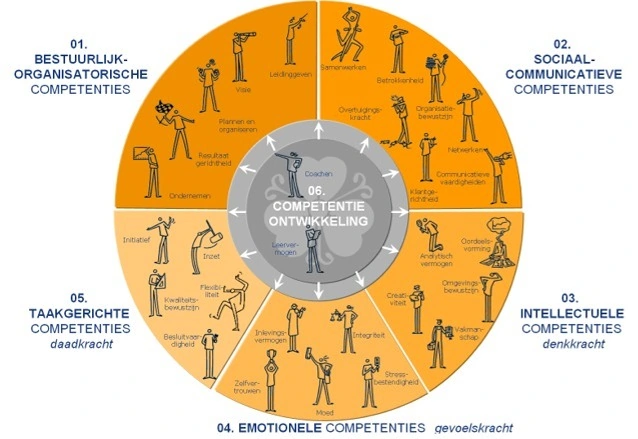
The competency model developed by MA Nieuwenhuis (2010) provides a valuable foundation for understanding human behaviour. Nieuwenhuis describes 29 behavioural competencies, divided into six competency areas: governance and organisation, social and communication, intellectual, emotional, task-oriented and competency development. The individual competencies are not considered in isolation, but always in relation to one another. This makes them valuable for self-awareness, coaching, leadership development, team building, recruitment, talent development and sustainable employability.
Select a competency below to explore its scientific background, practical examples, current research insights and relationship with the Voice Your Future voice analysis.
Governance and Organisational Competencies
1. Management
Providing direction, engaging people and delegating responsibility at operational, tactical or strategic levels.
2. Enterpreneurship
Recognising opportunities, taking initiative and turning possibilities into value for people, teams or organisations.
3. Planning and organising
Creating structure, setting priorities and ensuring tasks are carried out effectively.
4. Results-oriented
Setting goals, maintaining focus and working towards concrete results and visible impact.
5. Vision
Looking ahead, setting direction and translating developments into long-term choices.
Socially Communicative Competencies
6. Engagement
Feeling connected to people, work or the organisation and actively contributing to shared goals.
7. Communication skills
Communicating clearly, openly and effectively, while listening and adapting to others.
8. Customer orientation
Recognising needs, delivering value and acting from the customer’s perspective.
9. Networking
Building, maintaining and leveraging relationships to create mutual value.
10. Organizational awareness
Understanding how interests, relationships and decision-making work within an organisation.
11. Power of persuasion
Engaging others in ideas, choices or plans and building support.
12. Cooperation
Contributing effectively to shared goals, sharing information and coordinating with others.
Intellectual Competencies
13. Analytical ability
Researching information, identifying connections and turning complex issues into clear insights.
14. Creativity
Developing new ideas, thinking differently and combining existing knowledge in innovative ways.
15. Environmental awareness
Recognising external developments and translating them into opportunities, risks and appropriate choices.
16. Judgement
Weighing information, assessing interests and risks, and reaching a well-founded conclusion.
17. Craftmanship
Applying knowledge, experience and quality standards to act professionally, carefully and competently.
Emotional Competencies
18. Empathy
Sensing others’ feelings, needs and perspectives and responding appropriately.
19. Integrity
Acting with integrity, honesty and reliability, even when it is difficult.
20. Courage
Speaking up, taking responsibility and acting despite tension, resistance or uncertainty.
21. Stress resistance
Remaining calm, effective and resilient when pressure, setbacks or uncertainty increase.
22. Self-confidence
Trusting your own abilities, expressing your views and standing firm in different situations.
Task Oriented Competencies
23. Decisiveness
Making timely decisions and taking responsibility for the choices made.
24. Initiative
Identifying opportunities, taking action and assuming responsibility without waiting.
25. Quality awareness
Striving for high-quality work and acting carefully to achieve the best possible results.
26. Flexibility
Adapting to changing circumstances and dealing effectively with new situations.
27. Effort
Showing energy and engagement, working with motivation and actively pursuing goals.
Competency Development
28. Coaching
Guiding others in their development by increasing insight, encouraging reflection and enabling growth.
29. Learning capacity
Being open to new insights, using feedback and turning experiences into lasting development.

