Engagement
Engagement is not silent loyalty.
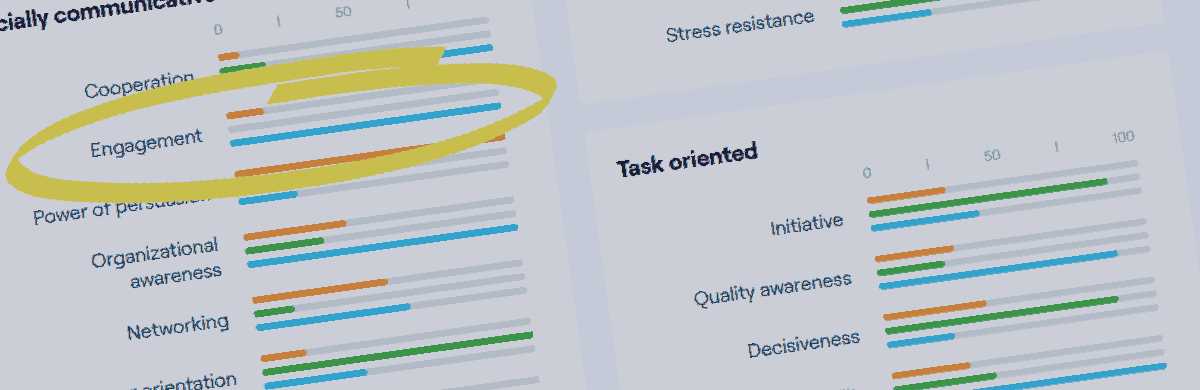
29 competencies. 1 voice.
Competency 6: Commitment
Commitment is the ability to express connection with work and the organisation through responsibility, choices and behaviour. Operationally, it means contributing reliably in one’s own work. Tactically, that connection is translated into shared effort, coordination and support. Strategically, people encourage commitment in others and connect goals and values to how the organisation is structured. The levels differ in scope; they do not rank people as more or less committed.
A familiar workplace situation
A team manager is discussing a change in service delivery. One employee responds enthusiastically and immediately offers to take on extra work. A second says little but has already investigated where the new approach might disadvantage customers. A third asks who will organise the handover between teams. Afterwards, the manager mainly describes the first employee as committed. The others’ contributions fade into the background.
Yet all three are focusing on something that matters to the organisation. The first shows effort, the second protects quality and the third takes responsibility for collaboration. Their behaviour differs, as do the risks they see. Enthusiasm is immediately recognisable. Care and coordination require closer attention to be recognised as commitment.
The conversation changes when the manager asks what each person wants to help achieve and what contribution is needed. It also becomes clear that extra effort has limits, critical questions can arise from responsibility and agreement alone does not produce a decision people can carry together. Assessing commitment starts with understanding the connection behind the behaviour and asking what behaviour the situation actually requires.
What is commitment?
Nieuwenhuis defines commitment as feeling connected to and being loyal to the organisation and the work. Loyalty is a related concept (Nieuwenhuis, 2010). This definition concerns a relationship: people identify sufficiently with the work and organisation to take responsibility for them. As a behavioural competency, that relationship becomes visible in what people do, discuss, support and sustain.
The competency description starts with taking responsibility for one’s own work, accepting goals and values, and following agreed working methods. A broader expression includes actively contributing to shared goals, supporting decisions and being willing to make an extra effort. At the strategic level, the focus is on encouraging commitment in others and communicating goals and values inside and outside the organisation. These descriptions underpin the three levels discussed later in this article.
Commitment is not the same as work engagement, satisfaction or staying. Work engagement primarily describes the energy and dedication people bring to their work. Job satisfaction concerns their evaluation of the work. Organisational commitment concerns their relationship with the employer. People can enjoy their profession while feeling little connection with the organisation, or remain loyal while their energy for the work declines. These differences matter for assessment and development.
The focus of commitment also deserves attention. Professionals may feel strongly connected to clients, colleagues, professional standards or a societal purpose. This can strengthen the organisation but can also create tension with a decision. Loyal behaviour therefore includes discussing situations where practices and values diverge and then seeking a workable contribution to the shared interest.
A role, a skill or a behavioural competency?
More than a job role
Commitment is expected of employees, advisers, managers and executives. A role determines where responsibility is needed, but it does not prove committed behaviour. A specialist can make a strong contribution to organisational interests without managing people. A manager can be formally responsible for a team while paying little attention to the connection between people and work.
More than a single skill
Listening, giving feedback, sharing information and bringing people along help make commitment visible. Individually, they do not prove connection. People can handle a conversation skilfully without taking responsibility for the outcome. Conversely, they can feel strongly committed while struggling to discuss that commitment or make it practically useful.
A behavioural competency
As a behavioural competency, commitment consists of connected attitudes, knowledge, skills and behaviour. People understand shared goals, consider their own actions in that light, take responsibility and maintain the connection their role requires. For HR, the question is therefore what behaviour is visible, what it is directed towards and under which conditions it is sustained.
Scientific foundations
Commitment and involvement are studied through several related constructs. Personal engagement, work engagement and organisational commitment overlap but have distinct definitions and measurement methods. They offer insights relevant to the competency without together constituting a single validated measure of its operational, tactical and strategic distribution. A careful discussion keeps these concepts distinct.
Kahn (1990) investigated how people bring themselves physically, cognitively and emotionally into their work role or withdraw from it. He identified meaningfulness, psychological safety and availability as relevant conditions. His research helps explain why presence does not equal genuine participation: people need to find the work meaningful, experience enough room to show themselves and have the resources to give it attention. This was qualitative research aimed at developing theory; its findings are not a universal behavioural formula.
Schaufeli, Bakker and Salanova (2006) describe work engagement as a positive state characterised by vigour, dedication and absorption. Their research concerns a questionnaire measuring that state. This differs from assessing loyal behaviour or the ability to connect others to organisational goals. Work engagement can support committed behaviour, but a visibly energetic approach does not automatically reveal how someone takes responsibility for the team and organisation.
Meyer and Allen (1991) distinguish three forms of organisational commitment. Affective commitment means wanting to stay because of emotional attachment. Continuance commitment means staying because leaving has costs. Normative commitment means feeling obliged to stay. The same outcome, remaining with an employer, can therefore have different foundations. Retention alone does not reliably indicate the quality of the connection. In a development conversation, what binds someone and what it means for their behaviour are relevant.
Research insight: an engaged state at work, attachment to the employer and committed behaviour are related but not interchangeable. For any measurement, ask which concept is being examined and connect the outcome to specific work situations.
Ryan and Deci’s self-determination theory (2000) describes autonomy, competence and relatedness as basic psychological needs. This theory helps explain the quality of motivation. People may make an effort because they value a task, but also because of pressure or guilt. The amount of effort cannot therefore carry the entire assessment of commitment. Opportunities to exercise influence, feel capable and belong also deserve attention.
In the Job Demands Resources model, Bakker and Demerouti (2007) connect workload to available resources. Job demands require effort; resources such as autonomy, feedback and support can sustain motivation. The model helps prevent declining commitment from being interpreted solely as a personal shortcoming. An employee showing little initiative may also face structural overload, unclear expectations or limited influence.
Meaningful work provides an additional line of research. In a meta-analysis, Allan and colleagues (2019) found strong associations with work engagement, commitment and job satisfaction. This supports attention to the perceived meaning of a contribution. It does not mean that an appealing mission alone causes commitment or that employees can bear unlimited demands when they value the work. Meaning needs to connect to work that is achievable.
Why this competency has so much impact
Commitment helps bridge the distance between a formal assignment and a contribution people genuinely feel responsible for. For employees, this can create greater coherence between values, professional expertise and daily work. For a team, it reveals who shares information, raises problems early and helps uphold agreements. For the organisation, it matters that people also take responsibility when a situation is not fully covered by a procedure.
Christian, Garza and Slaughter (2011) found associations between work engagement and both task performance and contextual performance in a quantitative review. Contextual performance concerns contributions to the wider work environment. Their research supports the importance of work engagement for functioning, but it does not prove that every behaviour labelled committed has the same effects. Translating these findings into a competency requires attention to the actual contribution.
In a meta-analysis, Krekel, Ward and De Neve (2019) examined 339 studies involving more than 1.8 million employees and over 82,000 business units. They found positive associations between employee satisfaction and customer loyalty, productivity and profitability, and a negative association with employee turnover. These data concern wellbeing and satisfaction in the studied workplaces. They should not be read as direct evidence for an individual commitment score.
The competency works within a network
Understanding connection
Empathy, collaboration and coaching help reveal what others need and how a shared contribution can grow.
Maintaining connection
Communication skills, organisational awareness and networking make expectations discussable and connect people across roles and teams.
Turning connection into action
Initiative, leadership and persuasiveness help translate responsibility into action and involve others in shared goals.
These connections guide development. Someone who understands the goals but rarely seeks contact faces a different question from someone who helps extensively but does not complete agreements. Strengthening commitment may therefore mean learning to listen better, express boundaries, weigh organisational interests or help make a decision achievable. More enthusiasm is not the appropriate development task for every situation.
Commitment also has a vulnerable side. People can take on too much responsibility, lose critical distance or subordinate their own boundaries to the team. Their effort then becomes difficult to sustain. Mature commitment includes setting boundaries, distributing work and identifying what the organisation needs to change. Caring for the shared result does not require constant personal overload.
The three levels of commitment
The three levels describe differences in the scope of committed behaviour: responsibility in one’s own work, effort towards shared delivery and encouraging commitment in others. The emphases used below, closeness to the work, connection and organisational capacity, help explain these differences. They are not separate scientific scales.
Operational
Taking responsibility in one’s own work and immediate work environment.
Tactical
Organising shared effort and maintaining the connection between people, agreements and goals.
Strategic
Encouraging commitment in others and connecting goals and values to organisational practice.
The levels do not rank behaviour from weak to strong. Their value depends on the contribution the role and situation require.
Each level explained in detail
Operational
Operational commitment concerns one’s own work and immediate work environment. The competency description includes taking responsibility, accepting goals and values, following agreed working methods and showing pride in the organisation. In practice, this can appear in completing work carefully, sharing information, participating in meetings and noticing when an agreement or colleague needs support.
The connection here is concrete: people understand what their contribution means for others and act accordingly. Warmth can help, but it is not a necessary expression. A quiet professional who reports an error promptly and repairs a handover also demonstrates committed behaviour. The relevant assessment concerns reliability, attention and responsibility in delivery.
Main strength
The main strength is closeness to the work. Operational commitment makes small signals visible before they become larger problems. It keeps shared goals connected to what customers, colleagues and processes need every day.
Relevant pitfall
The pitfall is that loyal assistance becomes constant taking over or serves only the immediate team. An employee can make themselves indispensable while concealing a structural capacity problem. Contributing responsibly therefore also includes asking for help and discussing boundaries.
Practical example
An employee notices that a colleague is missing handovers during a busy period. She asks what is happening, helps complete one urgent task and discusses with the manager how the schedule could be adjusted. The commitment consists of direct support and revealing the cause, so that helping does not quietly become a permanent extra task.
Tactical
Tactical commitment focuses on the connection between one’s own contribution and shared delivery. The competency description mentions actively contributing to goals and values, acting in the organisation’s interests, supporting decisions and willingness to make an extra effort. This article translates those behaviours into coordination, support and maintaining collaboration, making the description useful in team and change contexts.
Typical behaviour includes making expectations explicit, weighing interests, exchanging feedback and examining whether a decision can actually be implemented. Supporting a decision means taking responsibility for implementation while keeping relevant objections discussable. Psychological safety can help bring those objections forward; it does not mean the team must always agree.
Main strength
The main strength is organising connection. Tactical commitment prevents valuable individual efforts from remaining separate. People know who contributes what, where dependencies lie and when further coordination is needed.
Relevant pitfall
The pitfall is endless coordination or invisible maintenance without a clear outcome. Building support can also become pressure to agree. Commitment requires room for difference and, ultimately, clear agreements about responsibility and next steps.
Practical example
A manager notices that a new working method has been formally adopted but two teams are acting differently. She brings their concerns and dependencies together, clarifies which elements are fixed and where adjustments are possible. She then records the agreements and later checks whether the handover works. The conversation thus has a demonstrable follow-up.
Strategic
Strategic commitment concerns encouraging connection in others and communicating goals and values inside and outside the organisation. The competency description includes motivating, supporting, retaining and, where necessary, correcting people. Its scope extends beyond one task or team: people take responsibility for the ways others can connect to a shared purpose.
In practice, this becomes visible when goals and values shape decisions, leadership and work design. An executive might organise employee influence, change contradictory incentives and clarify why a direction has been chosen. This touches on vision and leadership, while the emphasis of commitment lies on the connection between people and shared purpose.
Main strength
The main strength is creating consistency between words and experience. Strategic commitment helps prevent organisations from asking for connection while policy and daily action make it harder. It makes commitment a responsibility of leadership and organisational design.
Relevant pitfall
The pitfall is an inspiring story without noticeable consequences. Another is confusing connection with uniformity: employees need to be able to discuss the values and contribute from different backgrounds. Otherwise, a strongly expressed culture may reinforce exclusion or silence.
Practical example
An executive team wants to innovate faster but notices employees hiding mistakes. It connects its direction to concrete agreements about experiments, discussing failures and decision making. Managers receive time and support to apply those agreements. The organisation then checks whether employees actually experience more room to contribute.
The three levels reinforce one another
Operational commitment keeps shared purpose connected to daily work. Tactical commitment turns individual effort into a coordinated contribution. Strategic commitment focuses on the goals, values and conditions that can sustain connection over time. Together, they create an interaction between experience, collaboration and organisational choices.
When one level is missing
A strong organisational direction without daily contact can become distant. Extensive mutual help without coordination can produce duplicated work or uneven workloads. Careful coordination without shared purpose can lead to meetings that offer little direction. The missing level reveals where an additional contribution is needed; it does not prove a lack of commitment in the people making the other contributions.
People do not need to be equally visible at every level. Within a team, they can complement one another, provided their contributions genuinely connect. The operational professional must be able to pass on signals, the manager must translate them and the executives must be willing to reconsider choices. This requires more than three individually high scores.
The development question is which level the situation needs and how the existing forms of commitment support one another. A higher strategic score alone does not prove a stronger connection.
Effective use starts with the right fit
Different roles require different forms of commitment. Specify what people need to take responsibility for, which relationships must be maintained and how much influence the role offers.
Operational strength
In customer contact, delivery and specialist work, value often lies in reliability, noticing signals and contributing carefully to the immediate work environment.
Tactical strength
In project leadership, onboarding, advisory work and middle management, coordination, shared effort and discussing dependencies are important.
Strategic strength
In cultural development, governance and organisational change, the emphasis more often falls on connecting others to goals and values and organising the conditions for this.
Research into person-environment fit distinguishes fit with the job, organisation, group and supervisor. Kristof-Brown, Zimmerman and Johnson (2005) investigated these forms of fit in a meta-analysis. This distinction is useful for commitment: people may be exceptionally suited to the job’s substance while identifying little with organisational practice. A general judgement about motivation then obscures an important difference.
Fit does not mean everyone must share the same beliefs, background or communication style. In selection, what matters is whether people can support the relevant goals and want to take responsibility for them. Ask which values create tension in a concrete situation and how the candidate handles it. A critical professional can help the organisation remain true to its stated purpose.
Decision making latitude also matters. Someone without authority cannot be expected to change organisational policy. An executive can be expected to do more than be personally helpful. Development works better when the desired contribution fits the available information, time and influence. Otherwise, an organisational design problem is wrongly turned into an individual improvement task.
Why organisations often misjudge this competency
Organisations often confuse commitment with presence, overtime, enthusiasm or agreement. These signals are easy to see, but they do not independently reveal why people make an effort or what that effort contributes.
A first error is assessing visible style instead of behaviour. An employee who contributes energetically to discussions may neglect responsibilities. A quiet colleague may prepare carefully and consistently fulfil agreements. Assess what people notice, discuss and follow up. Ask what consequences this has for others too.
A second error is interpreting critical questions as disloyalty. Edmondson (1999) found an association between psychological safety and learning behaviour in teams. When people dare to take interpersonal risks, relevant information becomes easier to discuss. An objection to a decision can therefore be a committed contribution. This does require distinguishing reasoned disagreement and responsibility for next steps from persistently obstructing collaboration.
A third error is equating little visible behaviour with indifference. First investigate what someone has been able to contribute and what the environment enabled. Lack of clarity, overload or earlier responses to disagreement may influence behaviour. Conversely, a difficult environment does not prove that every problem originates there. Assessment must examine both the personal contribution and available conditions.
In selection, a concrete case is more useful than asking whether someone is loyal. Ask about a decision the candidate did not fully support: what was discussed, which interest mattered, what did they do afterwards and what was the result? Also ask about a situation requiring extra effort and how boundaries were protected. Commitment then becomes visible as responsibility rather than a socially desirable self-description.
Why commitment matters today
Commitment matters today because organisations need continuity, change and sustainable employability simultaneously. People must honour existing agreements while connecting to new working methods. This combination can create tension: employees who feel considerable responsibility may struggle with changes they see as threatening quality or colleagues.
In its 2026 State of the Global Workplace report, Gallup states that 20% of employees worldwide were engaged in 2025 according to its own measurement method. For Europe, the figure was 12% (Gallup, 2026). These figures describe the work experience studied. They do not mean that the remaining employees cannot show committed behaviour, nor do they directly describe an individual VYF score. They do underline that organisations cannot take people’s perceived connection with work for granted.
Hybrid collaboration makes that connection less dependent on chance encounters. Teams need explicit agreements about availability, information, handovers and moments for discussing concerns. Physical presence can help, but it is not a complete solution. The relevant question is whether people understand their contribution, can reach one another and see that their signals have influence.
AI and digitalisation also change the challenge. When tasks are automated, it may become unclear what professional expertise and responsibility now concern. Organisations need to discuss what is changing, which quality standards must be protected and where human judgement remains necessary. Commitment then becomes visible through asking questions, learning and examining consequences for customers and colleagues. This application follows from the behavioural competency described; it is not a separately established effect of AI.
Constant change can also limit room for committed behaviour. When people repeatedly receive new priorities without time to complete agreements, reliable contributions become difficult. The practical task includes clarifying what comes first, what stops and who carries responsibility. Connection is then linked to work that remains achievable.
An example: from profile to development direction
First assessment
Operational commitment stands out: taking responsibility for one’s own work and immediate environment. Tactical commitment remains low.
Eighteen months later
Strategic commitment becomes more prominent: contributing to direction, culture and building the organisation. Tactical commitment remains low.
An anonymised practical case shows how commitment can take a different direction as someone’s work and responsibilities change. Initially, operational commitment is most prominent. The person takes responsibility for the work close at hand and responds to the needs of their immediate environment. Eighteen months later, they work at a start-up in which they have also invested their own money. Strategic commitment is more prominent in the later profile.
The meaning of this shift becomes clear when we examine the contribution behind the behaviour. At first, attention focuses on one’s own work and the people around it. Later, the organisation’s future comes more clearly into view: what are we building, which choices fit and how can we help others connect to it? Commitment takes on a broader scope.
The same connection takes a different form
Operational commitment relates to empathy and collaboration. People notice what a colleague needs, take a task seriously and want their daily contribution to be good. Strategic commitment also brings vision, initiative, entrepreneurship and organisational awareness into view. A picture of the future helps determine what someone wants to contribute to. Initiative sets that connection in motion. Entrepreneurship directs attention to opportunities and creating value. Organisational awareness helps reveal which people, interests and choices are needed.
The move to the start-up makes this broader connection concrete. Time, work and personal money are committed to the organisation’s future. The perspective changes too: a decision concerns more than one’s own task. It affects direction, continuity and other people’s contributions. The profile helps identify this change in how commitment is expressed.
Why the tactical layer still matters
The striking point is that tactical commitment remains low in both assessments. This reveals a development question that a general statement such as “this person is committed” can easily miss. Taking responsibility for one’s own work and investing in the organisation’s future are valuable contributions. Achieving them with others also requires maintaining connection every day.
This tactical layer takes shape through communication skills, collaboration and networking: discussing expectations, sharing information, involving colleagues and following up on agreements. Organisational awareness helps identify whom to coordinate with. Listening and empathy help explain why someone else has a different priority. Personal effort then becomes a shared contribution.
The insight that brings clarity
People can take considerable responsibility and feel strongly connected to an organisation’s future while giving less attention to the coordination between them. The development step is then to connect their own commitment more effectively with others’ contributions.
What personal preferences add
In this case, authenticity, autonomy and reluctance towards interactions where someone feels they must prove themselves are important themes. This makes the form of contact relevant. A substantive conversation about a shared issue may fit better than contact centred on visible presence. The Individualist personality emphasis highlights the importance of authenticity and a personal contribution. The Helper emphasis shows another route: seeking connection by being available and supporting others. Both routes can sustain commitment, each with its own development tension.
The Doer and Decider learning styles offer useful ways to make coordination concrete. A Doer can practise by tackling a real problem together and then reflecting on the interaction. A Decider can link a meeting to a clear question, a choice and a follow-up agreement. Maintaining relationships then gains a recognisable function in the work. Coordination becomes part of the result someone wants to contribute to.
A suitable development exercise
Choose one issue that matters to the organisation. Determine who is needed, discuss everyone’s expectations and make one shared agreement about the next step. Return to it two weeks later. Also ask what information or support the other person still needs. Initiative, communication and collaboration are then connected to a concrete contribution.
This analysis produces a focused development direction. The person does not need to reinvent their commitment. Their strength already lies in taking responsibility and building an organisation that matters. Greater attention to tactical coordination helps share that strength, enabling others to connect and strengthening the collective contribution.
What this means for organisations
For recruitment, commitment starts with role analysis. Describe the responsibility the role requires and what the candidate needs to connect to. Investigate this through comparable situations, concrete behavioural questions and attention to context. Willingness to work overtime should not replace assessing reliability, collaboration or the ability to involve others in goals.
For HR, the task is to connect selection, onboarding and development. New employees need clarity about goals, mutual expectations and how their contribution is valued. Also discuss where daily practice differs from the employer promise. An engagement survey can provide a signal, but the conversation must clarify the problem and the change that follows.
For team managers, attention needs consequences. Ask who risks disengaging, which dependencies are not being discussed properly and where responsibility is becoming unevenly distributed. Show what happens to the signals received. A conversation about commitment loses credibility when the same workload keeps being raised without changes to priorities or capacity.
For executives, commitment concerns organisational design and role modelling. Examine whether goals, rewards, decision making and leadership support the same direction. Asking for ownership requires clarifying where people genuinely have influence. Asking for loyalty requires tolerating relevant objections. Strategic commitment becomes credible when shared values are recognisable in difficult choices.
For career coaching, what matters is what people want to connect to and where that connection lacks room. This may lead to different behaviour, clearer boundaries, another role or another work environment. Some tensions concern the context as well as the person. Sometimes leaving is a considered decision by someone strongly committed to professional values and quality who has insufficient room to act on them within the organisation.
How Voice Your Future makes commitment visible
Voice Your Future reveals how people express commitment. Operationally, the emphasis lies on one’s own work and immediate environment. Tactically, it concerns shared effort and maintaining connection. Strategically, encouraging commitment in others and connecting to organisational goals come into view. This distribution helps explain where someone’s contribution naturally emerges and what additional contribution the role requires.
Connections with other competencies deepen the picture. Empathy and collaboration reveal how people connect with others. Communication skills and networking help explain how that connection is maintained. Initiative, vision, entrepreneurship and leadership give direction to how people take responsibility and involve others in a shared purpose.
Learning style and personality emphases make the development direction more personal. What energises someone? Which contribution feels meaningful? What makes coordination easy, and where does tension arise? Connecting these questions to recognisable situations clarifies which approach fits the person.
From a general judgement to personal insight
The difference between “you are committed” and an illuminating analysis lies in the connections: what do you take responsibility for, how do you connect your effort to others and which step helps your contribution realise its potential?
The score provides the starting point for that conversation. The profile helps identify strengths, name development tensions and choose a concrete next step. Commitment becomes visible as a personal way of contributing to work, people and the organisation.
The essence of commitment
Commitment reveals how people connect to work and the organisation. Operationally, it takes shape through responsibility for the daily contribution. Tactically, through shared effort and maintaining collaboration. Strategically, through encouraging commitment in others and connecting goals and values to organisational practice.
Strong commitment connects responsibility, coordination and meaning. It requires an appropriate personal contribution and workable conditions in the environment. Its quality lies in what that connection makes possible, alongside the amount of visible effort.
The essence is deliberate connection expressed in behaviour: knowing what you contribute to, taking responsibility for that contribution and discussing what is needed to sustain it together.
References
Allan, B. A., Batz-Barbarich, C., Sterling, H. M., & Tay, L. (2019). Outcomes of meaningful work: A meta-analysis. Journal of Management Studies, 56(3), 500–528. https://doi.org/10.1111/joms.12406
Bakker, A. B., & Demerouti, E. (2007). The Job Demands-Resources model: State of the art. Journal of Managerial Psychology, 22(3), 309–328. https://doi.org/10.1108/02683940710733115
Christian, M. S., Garza, A. S., & Slaughter, J. E. (2011). Work engagement: A quantitative review and test of its relations with task and contextual performance. Personnel Psychology, 64(1), 89–136. https://doi.org/10.1111/j.1744-6570.2010.01203.x
Edmondson, A. C. (1999). Psychological safety and learning behavior in work teams. Administrative Science Quarterly, 44(2), 350–383. https://doi.org/10.2307/2666999
Gallup. (2026). State of the global workplace: 2026 report. Global data summary. https://www.gallup.com/workplace/697904/state-of-the-global-workplace-global-data.aspx
Kahn, W. A. (1990). Psychological conditions of personal engagement and disengagement at work. Academy of Management Journal, 33(4), 692–724. https://doi.org/10.5465/256287
Krekel, C., Ward, G., & De Neve, J. E. (2019). Employee wellbeing, productivity and firm performance. Centre for Economic Performance, Discussion Paper No. 1605. https://cep.lse.ac.uk/_NEW/PUBLICATIONS/abstract.asp?index=6172
Kristof-Brown, A. L., Zimmerman, R. D., & Johnson, E. C. (2005). Consequences of individuals’ fit at work: A meta-analysis of person–job, person–organization, person–group, and person–supervisor fit. Personnel Psychology, 58(2), 281–342. https://doi.org/10.1111/j.1744-6570.2005.00672.x
Meyer, J. P., & Allen, N. J. (1991). A three-component conceptualization of organizational commitment. Human Resource Management Review, 1(1), 61–89. https://doi.org/10.1016/1053-4822(91)90011-Z
Nieuwenhuis, M. A. (2010). The art of management 1: Strategie en structuur (10e druk). M. Nieuwenhuis.
Ryan, R. M., & Deci, E. L. (2000). Self-determination theory and the facilitation of intrinsic motivation, social development, and well-being. American Psychologist, 55(1), 68–78. https://doi.org/10.1037/0003-066X.55.1.68
Schaufeli, W. B., Bakker, A. B., & Salanova, M. (2006). The measurement of work engagement with a short questionnaire: A cross-national study. Educational and Psychological Measurement, 66(4), 701–716. https://doi.org/10.1177/0013164405282471

