Environmental awareness
Turning external signals into choices
before changes become urgent.
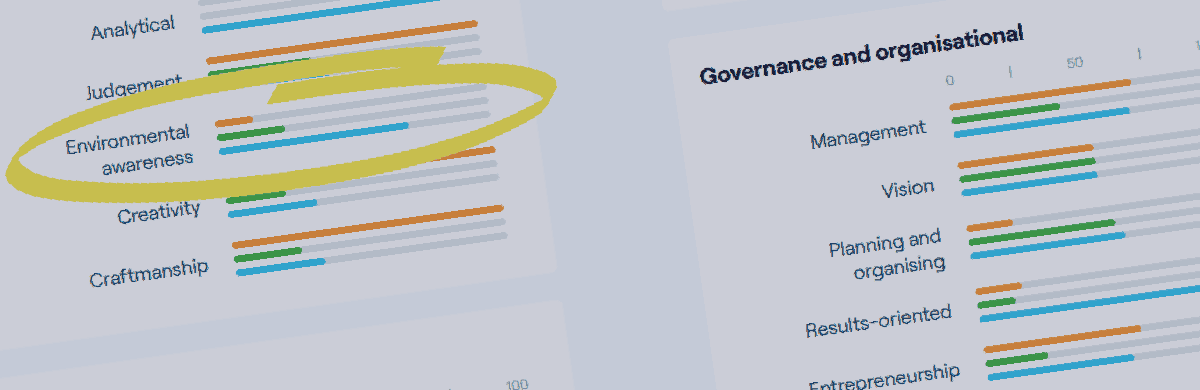
Competency 15: Environmental awareness
Environmental awareness is more than following the news or being able to name trends. It is the behavioural competency through which someone notices relevant social, political, technological, economic and professional developments, interprets them and uses them in their work, organisation or field.
In this article
A recognisable situation at work
A marketer presents a campaign that is sound and carefully developed. Yet the results fall short. During the evaluation, the team discovers that customers’ search behaviour has changed, a competitor is using a new positioning strategy and new AI rules affect the chosen content. All the information was available, but the signals were connected too late.
A good plan can become outdated before it is implemented.
This is exactly where environmental awareness becomes visible. It is not about collecting as much information as possible, but about recognising relevant change in time, testing signals and translating them into options for action.
What is environmental awareness?
Nieuwenhuis defines environmental awareness as following relevant developments in the organisation’s environment and using that knowledge for the organisation or professional field. Chain thinking is listed as a synonym. The focus explicitly extends beyond the immediate task and the organisation: social, political, technological, economic and professional developments (Nieuwenhuis, 2010).
At the operational level, someone stays informed and exchanges views with others. At the tactical level, information is interpreted, tested through knowledge networks and applied at work. At the strategic level, someone becomes a source of expertise, translates developments for the organisation and encourages others to exchange relevant information.
Environmental awareness therefore differs from organisational awareness. Organisational awareness focuses on internal relationships, interests and decision-making. Environmental awareness looks outward and brings the outside world into the organisation.
The competency connects detection, interpretation and application.
A role, skill or behavioural competency?
Environmental awareness is often confused with general knowledge, curiosity or an interest in current affairs. Those qualities can help, but they do not show whether someone selects and uses relevant information.
More than following the news
Reading widely does not guarantee that the right signals will be recognised. Information may be fragmented, unreliable or irrelevant to the person’s role.
More than predicting trends
A compelling story about the future may remain speculative. Professional environmental awareness makes uncertainty visible and distinguishes observation, interpretation and assumption.
A behavioural competency
The competency becomes visible in recurring behaviour: selecting sources, asking questions, checking information, discussing patterns, identifying consequences and translating insights into work-related decisions. For HR, it is therefore more precise to ask what environmental awareness behaviour a role requires than to describe someone generally as broadly interested.
Scientific foundation
In research, environmental awareness is most closely connected to environmental scanning, boundary spanning, absorptive capacity and strategic foresight. Research on environmental scanning is broad and fragmented. A systematic review identifies five perspectives and concludes that scanning can be both an individual and an organisational activity. The mechanism runs from seeking information through interpretation to strategic or operational application (Robinson et al., 2021).
Different sources reveal different realities
Auster and Choo (1994) studied how thirteen senior managers acquired and used external information. They combined multiple sources. Personal contacts were particularly important for information about customers and competitors; formal and written sources also contributed to knowledge about technology and regulation. The sample was small, but the study illustrates an important principle: source diversity reduces one-sidedness.
Bringing the outside world into the team
Boundary management includes activities through which teams maintain connections with their environment. A meta-analysis of 85 studies involving 10,848 teams found an overall positive relationship with team performance. The benefits were stronger for external information gathering, representation and coordination than for shielding teams. Activities performed by formal leaders were more effective on average, although outcomes varied by context and design (Leicht-Deobald et al., 2025).
Recognising information is not the same as using knowledge
Absorptive capacity concerns recognising the value of external knowledge, absorbing it and applying it productively. A meta-analysis of 241 studies found strong relationships with innovation and knowledge transfer. The relationship with financial performance operated through these two outcomes (Zou et al., 2018). This supports the structure of the competency: staying informed is necessary, but only application creates organisational value.
More information can produce less insight
A meta-analysis of 117 studies involving 133,011 people linked information overload to greater information avoidance, stress, burnout and fatigue, as well as lower performance and satisfaction (Graf & Antoni, 2023). Environmental awareness therefore does not require a constant stream of information, but a purposeful process of selection, verification and interpretation.
the quality of translation matters more than the quantity of information.
Why this competency has such an impact
Organisations make decisions before all information is complete. Those who notice external developments too late respond only after customers, technology, legislation or competitors have already changed the room for manoeuvre. Those who act on every signal immediately create unnecessary disruption. The impact therefore lies in responding both early and proportionately.
Strategic future orientation may be associated with performance. A longitudinal study linked future preparedness in 2008 with organisational performance in 2015. Companies classified as future-prepared had, on average, 33% higher profitability and 200% higher growth than the average. This is organisational research and does not provide causal evidence for individual scores (Rohrbeck & Kum, 2018).
The competency operates within a network
Closely related
Organisational awareness and analytical ability help connect external signals to internal relationships, patterns and consequences.
Supporting
Empathy, judgement and networking help people gather perspectives, assess reliability and gain access to information beyond their own tasks.
Action-oriented
Initiative, decisiveness and courage help turn insights into action, even when a signal is uncertain or uncomfortable.
None of these competencies automatically compensates for environmental awareness. Their value emerges when they are actually used to collect, assess and apply external information.
The three levels of environmental awareness
Nieuwenhuis distinguishes three levels that together form one information flow: staying informed, applying information and strengthening awareness in others.
Operational
Following external developments and exchanging views about them.
Tactical
Interpreting information, using knowledge networks and applying insights.
Strategic
Translating developments for the organisation and encouraging knowledge exchange.
The levels do not form a ranking from weak to strong. They describe different functions within the process.
Each level explained in detail
Operational
Operational environmental awareness starts with focused attention. Someone follows current social, political, technological and economic developments, stays up to date in their professional field and discusses signals with others. For a marketer, this may mean systematically monitoring customer questions, competitors, platform changes, regulation and consumer behaviour.
Main strength
Early detection. Change becomes visible before it has fully developed into a problem or opportunity.
Relevant pitfall
Monitoring broadly without selection creates noise. Following only sources that confirm existing ideas creates false certainty.
Example from practice
A marketer notices shifts in customer questions in search data and sales conversations. She checks the pattern across multiple sources and discusses it with the team before the campaign plan is finalised.
Tactical
Tactical environmental awareness makes information usable. Someone communicates the meaning of external developments, participates in knowledge networks and applies insights at work. The focus is not only on what is changing, but on the implications for priorities, target groups, propositions and ways of working.
Main strength
Translation. Separate signals are connected to a specific choice, hypothesis or experiment.
Relevant pitfall
A striking trend may be treated as relevant too quickly. Without source verification, counterarguments and testing, current events can begin to dictate policy.
Example from practice
After a change in platform reach, a marketer compares the organisation’s campaign data with industry knowledge and discussions with agencies. The team then tests two adjusted channel strategies before reallocating the budget.
Strategic
Strategic environmental awareness makes an organisation’s external orientation less dependent on one observant person. Someone acts as a source of expertise, translates developments for the organisation and encourages others to exchange knowledge. Scanning becomes part of decision-making, scenarios and collective reflection.
Main strength
Preparedness. The organisation can develop options earlier and does not have to start from scratch when circumstances change.
Relevant pitfall
Strategic interpretation may remain abstract or be given too much authority. Scenarios are tools, not predictions, and must continue to be informed by operational signals.
Example from practice
Every quarter, a marketing director organises an environmental review with sales, customer service, data, legal and product development. The team identifies signals, uncertainties, possible consequences and experiments, each with a clear owner.
The three levels reinforce each other
Operational monitoring produces signals. Tactical interpretation determines which signals are relevant and how they can be applied. Strategic design ensures that sources, discussions and decisions recur. Without monitoring, strategy becomes speculative; without application, information remains interesting but inert; without strategic routines, every team has to start again.
Balance prevents distortion
Extensive monitoring without prioritisation causes overload. Rapid application without sufficient sources increases the risk of chasing hype. Strategic language about the future without visible choices can undermine trust.
Mature environmental awareness connects broad attention with selective action.
Effective use starts with the right match
The required combination depends on the role, the decision horizon and the extent to which the work depends on the outside world.
Operational strength
In customer contact, communications, research and delivery, current awareness is important. The employee must recognise changes and share them in time.
Tactical strength
In marketing, consulting, product management and policy development, the focus is on interpreting information, using networks and translating insights into specific choices.
Strategic strength
In executive leadership, strategy, innovation and organisational development, the focus is on exploring multiple futures and embedding external orientation in decision-making.
The right match starts with the behaviour required by the role. A high strategic score does not replace current knowledge of relevant sources, and a high operational score does not guarantee useful interpretation.
Why organisations often assess this competency incorrectly
Organisations often assess environmental awareness through general knowledge, confident trend language or the number of reports someone reads. This rewards visibility, but says little about source quality, interpretation and application.
A second misconception is that more scanning is always better. Effective environmental awareness includes clear stopping rules: which questions are we trying to answer, which sources do we trust and when do we have enough information to make a decision?
A third misconception is that a strategic narrative is automatically future-proof. Assess separately how someone gathers information, identifies uncertainty, compares sources, defines implications and turns an insight into action. For example, ask candidates to analyse an incomplete market picture and explain which additional information they would need.
Trend sensitivity is not a reliable overall measure of environmental awareness.
Why this competency matters now
Demand for environmental awareness is increasing as organisations simultaneously face AI, sustainability, geopolitical uncertainty, changing consumer expectations and new regulation. The Future of Jobs Report 2025 expects 39% of core skills to change by 2030; 63% of employers identify skills gaps as a major barrier to transformation. Analytical thinking, systems thinking, technological literacy and environmental stewardship are becoming more important (World Economic Forum, 2025).
The European Commission uses strategic foresight to strengthen resilience and calls for proactive scanning of both risks and opportunities, including scenarios that are difficult to imagine. The report highlights geopolitical tensions, climate change, technology, demographics and disinformation, among other developments (European Commission, 2025a).
33%
Among Dutch companies with at least ten employees, 33% used AI technology in 2025, compared with 23% in 2024 (CBS, 2026).
Marketing is a major area of application. Of the Dutch companies using AI, 35% applied the technology in marketing or sales, more often than for any of the other surveyed purposes (CBS, 2025). From 2 August 2026, European transparency requirements also apply to certain AI systems and AI-generated or manipulated content. The Digital Services Act sets requirements for advertising transparency and restricts certain forms of targeting (European Commission, 2025b, 2026).
The CMO Survey of 308 marketing leaders found that respondents spent an average of 68.2% of their time on the present and 31.8% preparing for the future. Among those who felt pressure to demonstrate marketing value, 70.6% placed greater emphasis on short-term impact. These are self-reported findings, mainly from commercial organisations in the United States (The CMO Survey, 2026).
Diageo provides an example from practice. For Distilled 2025, the company analysed more than 160 million online conversations and combined data analysis with expert interpretation. It later formed a network with Kantar, Pinterest, Google, Unilever and Kraft Heinz, among others, for horizon scanning and collective synthesis. This illustrates source diversity and knowledge networks, but it is not an independent impact study (Diageo, 2025a, 2025b).
At the same time, this competency is under pressure
The same developments increase the risk of fragmentation. AI produces information faster, short-term targets reward immediate action and digital channels make every signal visible. Without selection and reflection, current events become a stream to which the organisation reacts without direction.
Environmental awareness is not about following everything, but about knowing in time what deserves attention and action.
An example: from profile to development direction
In a marketer’s profile, environmental awareness is visible at 29% operationally, 25% tactically and 70% strategically. This pattern does not prove aptitude or a fixed trait. It provides a hypothesis: meaning and direction are relatively visible, while systematic information gathering, exchange and application are less visible.
Operational
Tactical
Strategic
29% operational | 25% tactical | 70% strategic
The first step is to test this against behaviour at work. Which market, customer, competitor, technology and regulatory sources does the marketer follow? How are signals verified? When do they lead to a hypothesis, experiment or adjusted recommendation? The score only gains meaning when combined with the role, opportunities to demonstrate the behaviour, context and concrete consequences.
Other competencies can provide bridges. Strategic analytical ability (100%) can help interpret signals in context. Operational empathy and judgement (both 100%) can help recognise and assess customer and stakeholder signals. Tactical initiative (100%) can support the step towards an experiment, while networking (58%, 23% and 64%) can broaden access to diverse sources. These scores do not automatically explain or compensate for environmental awareness. They only become relevant through visible behaviour at work.
Personality shapes natural attention
Personality types can prompt useful reflection questions, but they do not predict a competency score. A recent meta-analysis found only weak relationships between team members’ personality traits and team performance, depending on context and outcome (Han et al., 2024).
For an Enthusiast with Helper as their self-image, one hypothesis is that opportunities, energy and human needs readily attract attention, while slow-moving, political or uncomfortable signals may be investigated later. The development question is then: which relevant information falls outside the person’s natural lens of attention? This is a question to test against experience, not an explanation for the scores of 29%, 25% and 70%.
Learning styles provide direction for practice
A Doer can learn through short field experiments, a Dreamer through broad observation, a Thinker through models and a Decider through application. However, consistently matching learning to learning styles is insufficiently supported by evidence. A meta-analysis of 21 studies, 101 effect sizes and 1,712 participants found the required supporting pattern in only 26% of outcomes (Clinton-Lisell & Litzinger, 2024).
The Decider learning style therefore cannot explain a score pattern. It can, however, inspire a practical exercise: select one weak external signal, formulate its possible meaning, design a small marketing test and then discuss which information was missing.
A profile is the beginning of focused investigation, not the end of an assessment.
What this means for organisations
For recruitment, environmental awareness starts with job analysis. Which external domains are relevant, how early must someone detect change and which decisions should follow? Use a realistic case in which the information is incomplete and partly contradictory.
- Recruitment: assess information gathering, interpretation and application separately.
- HR and managers: develop scanning through real work processes, with feedback on source selection and decision quality.
- Executive teams: organise time, ownership and decision points for external orientation.
Since September 2025, CompetentNL has provided a national language for skills, supporting education, career development and labour market matching (Government of the Netherlands, 2025). LinkedIn reports that 93% of 1,271 recruitment professionals surveyed consider accurate skills assessment crucial. Organisations with the highest number of skills-based searches were 12% more likely to be associated with a quality hire on the platform. This is an association based on platform and survey data, not a causal effect (LinkedIn, 2025).
Development can be embedded in recurring routines: a source map, a monthly signal review, contact with knowledge networks, scenarios and small experiments. Managers should avoid adding external orientation on top of an already full role. A meta-analysis of boundary-spanning behaviour found positive relationships with satisfaction, engagement, performance and innovation, but also with role stress (Lan et al., 2022).
For executive teams, the central question is how external insights enter decisions. Without a clear recipient, decision point and follow-up, scanning remains a reporting activity. Without room for dissent, it merely confirms the existing strategy.
How Voice Your Future makes environmental awareness visible
Voice Your Future makes environmental awareness visible through the distribution of operational, tactical and strategic behaviour. This creates a more precise conversation than a single overall score.
- Where is external information collected and shared?
- Where is that information interpreted and applied?
- Where are others helped to use relevant developments?
The profile generates hypotheses that are tested against work experience, observations and results. A low score does not indicate inability, and a high score does not guarantee quality in every context. The value lies in connecting the score to behaviour, role and development direction.
The essence of environmental awareness
Environmental awareness is the willingness and ability to follow relevant external developments and use that knowledge for one’s work, organisation and professional field. Operationally, it involves staying informed and exchanging views. Tactically, it involves interpreting information, using networks and applying insights. Strategically, it involves translation, acting as a source of expertise and encouraging knowledge exchange.
The strength lies not in having the most information, but in recognising earlier which change matters.
Seen this way, environmental awareness goes beyond knowledge of current affairs. The central question becomes whether signals are gathered reliably, interpreted collectively and translated into a better choice at the right time.
Bronnenlijst
Auster, E., & Choo, C. W. (1994). How senior managers acquire and use information in environmental scanning. Information Processing & Management, 30(5), 607-618. https://doi.org/10.1016/0306-4573(94)90073-6
Statistics Netherlands. (2025, 12 December). Bedrijven gebruiken AI vaakst voor marketing of verkoop. https://www.cbs.nl/nl-nl/nieuws/2025/50/bedrijven-gebruiken-ai-vaakst-voor-marketing-of-verkoop
Statistics Netherlands. (2026, 10 February). Digitalisering en kenniseconomie 2025: ICT-gebruik bij bedrijven. https://www.cbs.nl/nl-nl/longread/rapportages/2026/digitalisering-en-kenniseconomie-2025/3-ict-gebruik-bij-bedrijven
Clinton-Lisell, V., & Litzinger, C. (2024). Is it really a neuromyth? A meta-analysis of the learning styles matching hypothesis. Frontiers in Psychology, 15, Article 1428732. https://doi.org/10.3389/fpsyg.2024.1428732
Diageo. (2025a, 7 January). Diageo identifies 2025 socialising trends in new global report. https://www.diageo.com/~/media/Files/D/Diageo-V2/Diageo-Corp/press-release/2025/diageo-identifies-2025-socialising-trends-in-new-global-report.pdf
Diageo. (2025b, 26 september). Diageo launches cross-industry network to reimagine how the world will socialise in the next decade. https://www.diageo.com/en/news-and-media/press-releases/2025/diageo-launches-cross-industry-network-to-reimagine-how-the-world-will-socialise-in-the-next-decade
European Commission. (2025a). 2025 Strategic Foresight Report: Resilience 2.0. https://commission.europa.eu/strategy-and-policy/strategic-foresight/2025-strategic-foresight-report_en
European Commission. (2025b, 22 September). Digital Services Act: Keeping us safe online. https://commission.europa.eu/news-and-media/news/digital-services-act-keeping-us-safe-online-2025-09-22_en
European Commission. (2026, 31 July). Commission starts enforcing AI Act rules and new transparency requirements on 2 August. https://digital-strategy.ec.europa.eu/en/news/commission-starts-enforcing-ai-act-rules-and-new-transparency-requirements-2-august
Graf, B., & Antoni, C. H. (2023). Drowning in the flood of information: A meta-analysis on the relation between information overload, behaviour, experience, and health and moderating factors. European Journal of Work and Organizational Psychology, 32(2), 173-198. https://doi.org/10.1080/1359432X.2022.2118051
Han, A., Krieger, F., Kim, S., Nixon, N., & Greiff, S. (2024). Revisiting the relationship between team members’ personality and their team’s performance: A meta-analysis. Journal of Research in Personality, 112, Article 104526. https://doi.org/10.1016/j.jrp.2024.104526
Lan, Y., Li, C., Wang, J., & Meng, X. (2022). Benefits and costs of employee boundary-spanning behavior: A meta-analytic review. Acta Psychologica Sinica, 54(6), 665-683. https://doi.org/10.3724/SP.J.1041.2022.00665
Leicht-Deobald, U., Backmann, J., de Vries, T. A., Weiss, M., Hohmann, S., Walter, F., van der Vegt, G. S., & Hoegl, M. (2025). A contingency framework for the performance consequences of team boundary management: A meta-analysis of 30 years of research. Journal of Management, 51(2), 704-747. https://doi.org/10.1177/01492063231206107
LinkedIn. (2025). The future of recruiting 2025. https://business.linkedin.com/content/dam/me/business/en-us/talent-solutions/resources/pdfs/future-of-recruiting-2025.pdf
Nieuwenhuis, M. A. (2010). The art of management. Retrieved via 123management.nl.
Government of the Netherlands. (2025, 24 September). Nederland krijgt een nationale standaard om vaardigheden te beschrijven. https://www.rijksoverheid.nl/actueel/nieuws/2025/09/24/nederland-krijgt-een-nationale-standaard-om-vaardigheden-te-beschrijven
Robinson, C. V., Ahmad, F., & Simmons, J. E. L. (2021). Consolidation and fragmentation in environmental scanning: A review and research agenda. Long Range Planning, 54(3), Article 101997. https://doi.org/10.1016/j.lrp.2020.101997
Rohrbeck, R., & Kum, M. E. (2018). Corporate foresight and its impact on firm performance: A longitudinal analysis. Technological Forecasting and Social Change, 129, 105-116. https://doi.org/10.1016/j.techfore.2017.12.013
The CMO Survey. (2026). The CMO Survey topline report: Spring 2026. https://cmosurvey.org/wp-content/uploads/2026/03/The_CMO_Survey-Topline_Report-2026.pdf
World Economic Forum. (2025). The Future of Jobs Report 2025. https://www.weforum.org/publications/the-future-of-jobs-report-2025/
Zou, T., Ertug, G., & George, G. (2018). The capacity to innovate: A meta-analysis of absorptive capacity. Innovation, 20(2), 87-121. https://doi.org/10.1080/14479338.2018.1428105

