Planning and organising
Do good intentions actually become reality?
Competency 3: Planning and organizing
This is exactly where the competency of planning and organizing becomes visible. Not as an administrative skill, but as a behavioral competency that determines whether goals are translated into executable work. Planning and organizing is about directing time, attention, resources, people and energy. It is the competency that prevents work from fragmenting into separate tasks, competing priorities and disconnected good intentions.
In this article
A recognizable real-world situation
Most organizations do not lack ambition. There are goals, projects, quarterly plans, team meetings, dashboards, development conversations and strategic priorities. Yet goals are not always achieved as intended. Everyone works hard, but not always in the same direction. Teams are busy, but progress feels fragile. Deadlines shift. There is plenty of coordination, but too little completion. Or there may be an excellent strategic plan while no one knows exactly what should happen differently on Monday compared with the week before.
This is exactly where the competency of planning and organizing becomes visible. Not as an administrative skill, but as a behavioral competency that determines whether goals are translated into executable work. Planning and organizing is about directing time, attention, resources, people and energy. It is the competency that prevents work from fragmenting into separate tasks, competing priorities and disconnected good intentions.
At a time when work is becoming increasingly complex, this competency matters more than ever. Microsoft describes in its Work Trend Index (2025) how knowledge workers are interrupted on average every two minutes during core working hours by meetings, emails or chats. For heavy users, this amounts to hundreds of interruptions a day. A large proportion of meetings are also unscheduled or ad hoc. Asana (2026) shows in the Anatomy of Work that knowledge workers spend a great deal of time communicating about work, searching for information and dealing with shifting priorities, rather than doing the substantive work they were hired to do.
In precisely this kind of working environment, planning and organizing is not a bonus. It is a prerequisite for focus, collaboration, job satisfaction and results.
What is planning and organizing?
According to the official competency definition, planning and organizing means effectively determining goals and priorities and identifying the time, activities and resources required to achieve specific objectives. Related concepts include organizational ability, delegation and progress monitoring.
This definition is concise, but rich in meaning. It contains four distinct elements.
First, it is about setting goals. If you do not know what needs to be achieved, you cannot prioritize effectively. Next comes making choices. Not everything can happen at once, not everything is equally important and not everything deserves the same attention. Then resources must be organized: time, people, information, budget, energy and conditions. Finally, progress must be monitored. A plan only becomes valuable when it is clear whether it is working, where adjustments are needed and who remains responsible for what.
Planning and organizing is therefore not the same as having a full calendar. Nor is it the same as being busy. In fact, one of the biggest pitfalls of this competency is confusing busyness with productivity. Someone can be constantly occupied, tick off many tasks and still contribute very little to the larger goal.
The essence of planning and organizing is consciously connecting behavior, time and resources to a desired result.
Role, skill or behavioral competency?
Planning and organizing is often approached as a practical skill. Can you create a schedule? Can you maintain a task list? Can you monitor deadlines? These are important elements, but they are not enough.
Skill
Planning and organizing is often approached as a practical skill. Can you create a schedule? Can you maintain a task list? Can you monitor deadlines? These are important elements, but they are not enough.
Behavioral competency
In reality, planning and organizing is a behavioral competency. This means it is not only about what someone knows, but above all about what they actually do under pressure. Can they maintain an overview when multiple interests are at stake? Do they dare to set priorities when everything seems urgent? Can they adjust a plan without losing direction? Do they make expectations explicit about who does what and when? Do they continue to monitor progress even when the work becomes less enjoyable?
Competency network
That is why planning and organizing is also closely connected to other competencies. Results orientation, for example, helps keep the goal in sight. Decisiveness is needed to make choices about sequence and priority. Vision provides the broader framework. Initiative helps create structure without being asked. Quality orientation determines what the plan should deliver. Organizational awareness reveals how the environment affects the plan. Commitment ensures that planned actions are actually carried out. Flexibility helps when reality disrupts the plan.
Anyone who sees planning and organizing only as time management misses half of the competency. Planning and organizing connects thinking with doing, goals with behavior, and individuals with the organization.
Scientific foundation
Scientific research related to planning and organizing comes from several fields: goal-setting theory, self-regulation, time management, team planning, leadership and organizational psychology.
An important foundation is Locke and Latham’s Goal Setting Theory (2002). Their research shows that specific and challenging goals often lead to better performance than general intentions such as “do your best.” But goals do not work automatically. They require feedback, commitment, task knowledge and viable strategies. This is crucial for planning and organizing. A goal without a plan remains abstract. A plan without a goal becomes arbitrary.
In their meta-analysis of implementation intentions, Gollwitzer and Sheeran (2006) show that goals become more powerful when people determine in advance when, where and how they will act. These if-then plans have a clear positive effect on goal attainment. This helps explain why operational planning is so important. Wanting to finish something is not enough. Effective behavior requires a concrete link between situation and action.
Self-regulation is also relevant. Lord, Diefendorff, Schmidt and Hall (2010) describe self-regulation at work as the process through which people select goals, monitor progress, adjust behavior and direct attention toward what is needed. Planning and organizing is therefore not a static schedule, but a continuous process of regulation. You plan, execute, notice what is going differently, adjust and monitor again.
Meta-analytic research on time management shows that time management is positively associated with job performance, academic performance and well-being, and negatively associated with stress and distress (Aeon et al., 2021). Interestingly, time management supports not only performance but also well-being. Structure helps people not only get more done, but also feel less overwhelmed.
The relationship is equally clear for teams. In their meta-analysis of 1,885 teams, Konradt, Nath and Oldeweme (2023) found a moderately positive relationship between team planning and team performance. This means that planning is not only individual behavior, but also a team process. Teams perform better when goals, roles, actions, timing and dependencies are made explicit.
Why this competency has such a strong impact
The competency of planning and organizing operates at several levels simultaneously.
At the individual level, it provides a sense of control. People who can structure, prioritize and adjust their work generally experience more control over their tasks. In Schaufeli’s Job Demands Resources model (2017), the workload a person experiences is determined not only by the demands they face, but also by the resources available to deal with them. Structure, autonomy, feedback and development opportunities can make workload more manageable and contribute to engagement. In this sense, planning and organizing functions as both a personal and organizational resource.
At team level, the competency helps prevent misunderstandings. Much of the friction in teams does not arise because people are unwilling, but because expectations remain implicit. Who does what? When will something be finished? What takes priority? Which dependency is blocking the next step? Tactical planning makes these issues explicit and discussable.
At organizational level, planning and organizing connects strategy with execution. Many organizations do not lack plans, but they do lack workable translation into practice. Strategic goals only become effective when they are embedded in cadence, capacity, ownership, decision-making and progress monitoring.
This is why this competency is so relevant to HR, recruitment, team management and executive teams. It determines not only whether someone keeps their own work under control, but also whether teams can deliver reliably and organizations can stay on course.
Why organizations often assess this competency incorrectly
Organizations often assess planning and organizing based on visible order. Someone with a tightly managed calendar, clear lists and fast follow-up is quickly seen as well organized. That impression may be correct, but it is not the whole story.
An employee can be very strong operationally and still struggle with tactical or strategic planning. Tasks may be completed neatly, but perhaps without sufficient prioritization, coherence or future orientation. Conversely, someone may be strategically strong, think ahead effectively and see connections, yet struggle with daily follow-up and progress monitoring. The result can be plans that are strong in substance but fail to translate sufficiently into execution.
A second assessment error is confusing planning with control. Good planning does not mean that everything is fixed in advance. In dynamic work, flexibility is actually part of the competency. An effective plan provides direction while leaving room for adjustment.
A third error is focusing mainly on intention. Someone may know exactly how planning works and still struggle to put it into practice. Especially in operational planning, the gap between knowing and doing can be substantial. Daily structure requires repetition, discipline and attention to small follow-up actions. That behavior does not come equally naturally to everyone.
The phenomenon known as the “planning fallacy” also shows why this goes wrong at organizational level. People and organizations often underestimate the time, costs and risks involved in projects. Because of optimism bias and a focus on ‘best-case’ scenarios, plans are often assessed unrealistically positively. Research published by the Project Management Institute describes how projects are regularly estimated too optimistically and are later delivered late, over budget or with reduced scope (Grushka-Cockayne et al., 2012). The pitfall lies not only in poor planning, but also in an overly optimistic assessment of reality.
The three levels of planning and organizing
The competency of planning and organizing only becomes meaningful when it is clear at which level someone plans: operational, tactical or strategic.
Operational
Effectively planning and organizing one’s own work.
Tactical
Coordinating one’s own work and that of others.
Strategic
Providing direction at a high level.
Operational
At the operational level, planning and organizing concerns one’s own day-to-day work. A person knows what needs to be done, takes initiative within established boundaries, sets goals and priorities in their own work, completes work on time and keeps commitments.
Tactical
At the tactical level, planning and organizing goes beyond one’s own task list. It is about coordinating one’s own work and that of others. A person organizes resources, maintains an overview of tasks, indicates how work can be structured efficiently and effectively, makes clear agreements and sets goals and priorities for themselves and others.
Strategic
At the strategic level, planning and organizing becomes a leadership competency. It involves providing direction at a high level, allocating resources efficiently and effectively, directing the planning and organization of work, supporting others in doing so and anticipating relevant developments that may affect organizational goals.
Operational level: effectively planning and organizing one’s own work
At the operational level, planning and organizing concerns one’s own day-to-day work. A person knows what needs to be done, takes initiative within established boundaries, sets goals and priorities in their own work, completes work on time and keeps commitments.
In concrete terms, this means turning tasks into a workable sequence. What needs to happen first? What can wait? What belongs today, and what can come later? This level also requires realistic time estimates, breaking larger tasks into smaller steps, monitoring deadlines and handling minor disruptions without losing sight of the bigger picture.
The behaviors are often small, but essential. Confirming an appointment. Being able to retrieve a document. Finishing one task before starting the next. Beginning the day with priorities rather than reacting to whatever comes in first.
Pitfall
The pitfall at this level lies in execution. Someone may confuse busyness with productivity. A great deal gets done, but not always what contributes most. Another pitfall is micromanagement: becoming so focused on details that the overall picture is lost. Rigidity can also occur. The plan then becomes untouchable, even when the situation calls for adjustment. At the other extreme, procrastination can arise when operational planning requires repetition and discipline.
Real-world example
A recognizable example is the employee who puts a great deal of energy into individual requests, responds quickly to messages and is available all day, only to realize at the end of the week that the most important task has still not been completed. Not because the task was unknown, but because it was never given a sufficiently concrete place in terms of time, attention and priority.
Tactical level: coordinating one’s own work and that of others
At the tactical level, planning and organizing goes beyond one’s own task list. It is about coordinating one’s own work and that of others. A person organizes resources, maintains an overview of tasks, indicates how work can be structured efficiently and effectively, makes clear agreements and sets goals and priorities for themselves and others.
This level becomes important as soon as work depends on multiple people, teams, projects or resources. Tactical planning requires someone to recognize dependencies. What must be completed before someone else can continue? Where is capacity constrained? Which agreement is still unclear? Where is delay likely? Who needs to be involved?
Behaviors at this level include coordinating, prioritizing, switching between issues, making expectations explicit, allocating capacity and adjusting course. Someone who is tactically strong often prevents problems before others even realize they could have occurred. This can make the competency almost invisible. Good coordination feels effortless precisely because the chaos never materializes.
Pitfall
The pitfall here lies in coordination itself. People can keep coordinating endlessly without moving into execution. Priorities may continue to shift, making everything seem urgent while nothing is truly completed. Dependence on others can also cause frustration. Tactical planning only works when others deliver too. If they do not, the coordinator comes under pressure. Another pitfall is losing the common thread. Constantly switching between people, tasks and levels can cause the strategic objective to fade from view.
Real-world example
An example is the project manager who involves everyone, discusses every risk and continually adjusts course, but notices that the team is becoming exhausted by meetings. The intention is good: to create alignment. But if alignment does not lead to decisions, ownership and action, tactical planning becomes a brake rather than an accelerator.
Strategic level: providing direction at a high level
At the strategic level, planning and organizing becomes a leadership competency. It involves providing direction at a high level, allocating resources efficiently and effectively, directing the planning and organization of work, supporting others in doing so and anticipating relevant developments that may affect organizational goals.
This level requires a longer time horizon and the ability to think abstractly. Where are we going? What will we do, and what will we deliberately not do? Which resources will we allocate to what? Which patterns show that the current way of working is not sustainable? How do we ensure that the structure does not remain dependent on one person, but can be supported by the team or organization?
Strategic planning also means connecting day-to-day activities to larger goals. Why are we doing this in the first place? Does this activity still contribute to our direction? Should we accelerate, slow down, stop or reallocate?
Pitfall
The pitfall is getting stuck in the big picture. Plans may be strong in substance but fail to translate into execution. Strategy then remains at the level of ideas. Another pitfall is abstraction without action. There is thinking, analysis and conceptualization, but no one knows what needs to happen tomorrow. Strategic thinkers may also underestimate the complexity of execution. They see the broad direction clearly, but sometimes have little patience for day-to-day implementation. Finally, there is the risk of overplanning: considering so many scenarios that decision-making slows down.
Real-world example
An example is an executive team presenting a clear strategic plan with ambitious goals for growth, innovation and customer focus. Teams understand the direction, but wonder what it means for capacity, priorities, meeting structures and ongoing projects. Without tactical and operational translation, strategy remains inspiring but insufficiently executable.
The three levels reinforce each other
The strength of planning and organizing does not lie in any single level, but in the connection between all three.
Operational planning ensures that work actually gets done. Tactical planning ensures that people, resources and dependencies are aligned. Strategic planning ensures that all this effort is directed toward the right goals.
When one level is missing, recognizable problems arise. Someone who is strategically strong but operationally weak creates plans that are not executed sufficiently. Someone who is operationally strong but strategically weak works hard on tasks that do not always contribute most. Someone who is tactically strong but lacks strategic clarity may coordinate extensively without a clear direction. Someone who is strong strategically and operationally but less strong tactically may achieve a great deal personally while struggling to bring others along.
It is the connection between the levels that matters
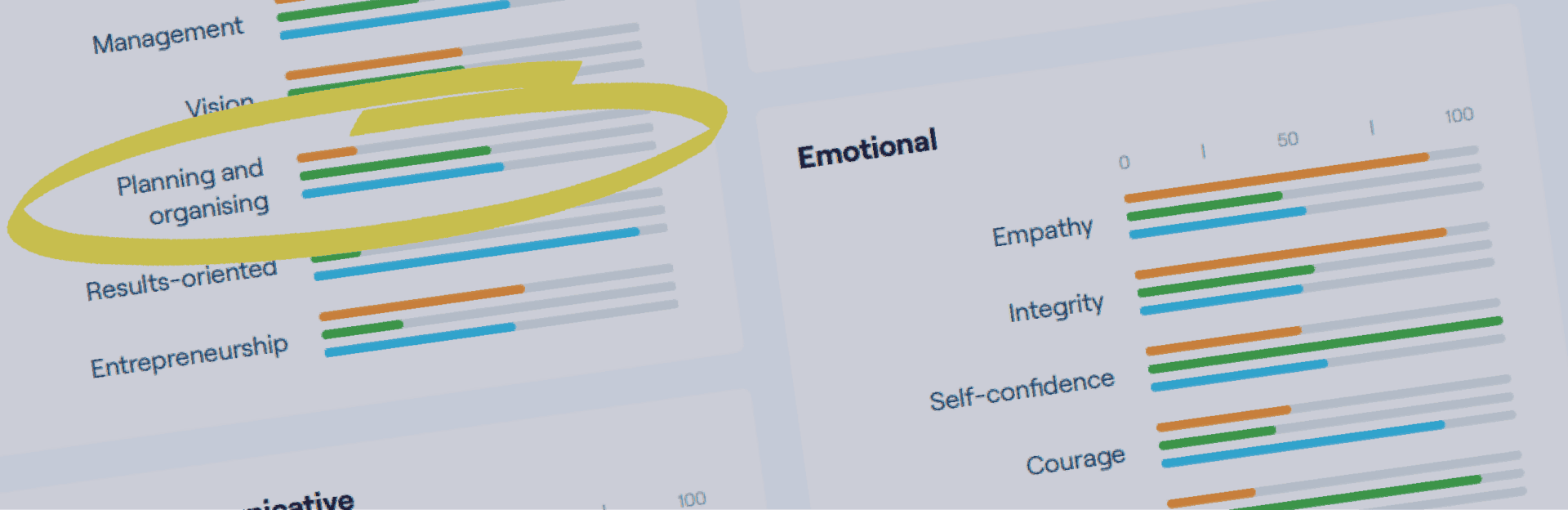
In one individual analysis, for example, we saw a profile with low operational scores and stronger tactical and strategic scores. This profile does not show that someone cannot plan. It shows that their natural behavioral tendency lies more in seeing connections, switching between issues, coordinating and thinking ahead than in daily routine, repetition and task discipline. That distinction matters. Planning and organizing is not an all-or-nothing competency. Someone can be strong at the level that naturally gives them energy and still perform well at a lower-scoring level, but may need more deliberate structure, attention or support there.
Effective use starts with the right match
Effective use of planning and organizing starts with looking carefully at the level at which the role requires this competency. Not every role requires the same form of planning. Sometimes reliable execution is central, sometimes coordination between people and resources, and sometimes strategic direction at a high level.
Operational reliability
For some roles, operational reliability is crucial. Think of roles in which deadlines, procedures, safety, follow-up and accuracy are central. In such roles, risk arises when someone contributes to the bigger picture but does not monitor day-to-day progress sufficiently.
Tactical coordination
For other roles, tactical coordination is decisive. Project managers, team coordinators, HR business partners and operations professionals need to recognize dependencies, manage expectations, allocate capacity and adjust when priorities shift.
Strategic direction
For executive teams, senior management and strategic advisory roles, the strategic level is essential. Here the focus is on making choices, directing resources, anticipating future developments and building structures that outlast today’s agenda.
A good match therefore begins with two questions: what level of planning and organizing does this specific role require? And at which level does this person naturally display their strongest behavior?
The match between person and work
The match between person and work then comes down to whether someone’s natural way of planning aligns with what the role and working environment demand each day. A role may formally require the same competency, yet look very different in practice. A policy adviser, project manager, team manager and executive all need planning and organizing, but not in the same way or with the same emphasis.
Research on job performance shows that traits such as reliability, discipline, orderliness and goal orientation are associated with effective functioning. In their classic meta-analysis, Barrick and Mount found that conscientiousness is consistently related to job performance across different occupations and criteria (Barrick & Mount, 1991). This supports the importance of behaviors such as keeping commitments, staying focused on goals and completing work carefully. At the same time, this does not mean there is only one good way to plan. Someone may be strong in daily execution but less naturally inclined toward strategic thinking. Another person may excel at looking ahead and seeing connections but struggle with repetition, follow-up and concrete task discipline.
That is why, when considering planning and organizing, it is important not only to ask whether someone “has” this competency, but above all at which level it becomes visible. The right question is: does someone’s natural way of planning align with what the role requires? Where does strength come naturally, and where are support, collaboration or development needed? It is precisely this match that determines whether planning and organizing leads to clarity, progress and results.
Demand for planning and organizing is increasing
Current labor market developments are making planning and organizing increasingly important. In The Future of Jobs Report 2025, the World Economic Forum (2025) describes how technological change, economic uncertainty, demographic shifts and the green transition will strongly influence the labor market toward 2030. Skills such as leadership, talent management, analytical thinking, flexibility, agility and self-awareness are becoming more important.
These are all areas in which planning and organizing plays a supporting role. Organizations implementing AI need to redesign processes. Hybrid work requires more explicit agreements. Supporting employee development requires organizing goals, learning paths and progress. Pursuing sustainability, innovation or growth requires choices about resources and priorities.
HR and recruitment are also moving increasingly toward skills-based hiring. NACE reported in 2026 that 70 percent of participating employers recruit based on skills and competencies, up from the previous year. Employers use this approach primarily in interviews, screening, job descriptions and assessment rubrics. SHRM (2025a, 2025b) shows that many organizations struggle to fill roles because of technical and soft skill gaps, while existing roles are changing as a result of growth and technology.
For planning and organizing, this means organizations need to make the competency more concrete. Do not ask, “Are you well organized?” Instead, explore: how does someone set priorities? How do they monitor progress? How do they respond to disruption? How do they make agreements? How do they translate goals into actions?
At the same time, this competency is under pressure
Precisely as planning and organizing becomes more important, the competency itself is under pressure.
Work has become more fragmented. Digital communication creates constant interruptions. Hybrid collaboration requires more explicit coordination. Projects increasingly span functions, teams and time zones. Roles change more quickly. Organizations demand greater flexibility while often maintaining the same volume of work.
This makes planning more complex. A task list is no longer enough when priorities shift daily. An annual plan is insufficient when technology or market developments change along the way. A meeting solves little when ownership and decision-making remain unclear.
The pressure also lies in the tension between flexibility and structure. Many modern organizations want to be agile. That is understandable, but agility without planning quickly becomes reactive behavior. Everything then becomes urgent, priorities keep shifting and work becomes fragmented. Good planning does not stand in the way of flexibility. It actually enables flexibility, because the intended direction is clear and deviations can be made deliberately.
Why self-awareness makes the difference
Self-awareness is essential in planning and organizing because people often have a natural preference for a particular level of planning.
Some people feel comfortable with operational structure. They like working with lists, deadlines, sequences and clear agreements. Their strength is reliability. Their pitfall can be rigidity.
Others feel stronger at the tactical level. They switch easily between people, interests and tasks. They recognize dependencies and keep the whole system moving. Their strength is coordination. Their pitfall can be continuing to align without completing enough.
Still others think primarily at a strategic level. They see patterns, future developments and broader connections. Their strength is providing direction. Their pitfall can be that plans remain insufficiently concrete.
Activist
The connection with learning styles helps explain why someone may naturally be strong at one level of planning and organizing while another level requires more conscious attention. The Activist learns primarily through experience, action and direct application. Operational planning can fit this well because it involves taking action, executing and making visible progress. At the same time, the Activist may struggle with lengthy preparation or reflection before acting.
Pragmatist
The Pragmatist is practical, results-oriented and focused on applying what works. This learning style often fits tactical planning well: making choices, switching between issues, setting priorities and creating momentum. At the same time, there is an important distinction between acting quickly and executing with discipline. Operational planning requires not only action, but also repetition, routine and consistent follow-up. This can be less natural for a Pragmatist when the immediate result is not yet visible.
Reflector
The Reflector looks at situations from multiple perspectives, senses interpersonal dynamics and often understands what is happening between people, interests and circumstances. This can make the learning style valuable for tactical and strategic planning and organizing. Tactical planning requires alignment, switching and weighing interests. Strategic planning requires seeing connections, thinking ahead and placing choices in a broader context. The pitfall is that many possibilities remain visible, which can make choosing, completing or prioritizing firmly more demanding.
Theorist
The Theorist looks for coherence, logic and evidence. This learning style aligns particularly well with strategic planning: seeing broader connections, thinking through scenarios, designing structures and linking choices to long-term goals. The pitfall is that planning can remain in the analysis phase for too long. The thinking may be strong, but the step toward execution is delayed.
In an individual case involving the Reflector learning style, this pattern becomes clear. The participant scored low on operational planning and more strongly on tactical and strategic planning. This makes sense: the Reflector naturally operates through observing, connecting, considering and creating meaning. As a result, overview, alignment and direction often come more naturally than daily routine, task discipline and consistent follow-up. A low operational score therefore does not mean that someone cannot plan. It mainly shows that daily structure needs to be organized more consciously, while natural strength lies more in seeing connections, weighing interests and connecting people with direction.
In this way, the combination of scores and learning style makes the development question more concrete. The aim is not to lock someone into a judgment, but to understand which aspects of planning and organizing naturally provide energy and which require support, rhythm or collaboration.
Why self-awareness makes a difference for each personality type
Personality patterns also shape what planning and organizing looks like.
A Perfectionist often plans from a need for quality and control. This can be operationally strong, but may become rigid under pressure. A Helper plans around what others need, making their own schedule vulnerable to outside requests. An Achiever plans around results and efficiency, but may overfill their own schedule. An Individualist plans from meaning and inner conviction, but may struggle with routine. An Observer plans from overview and autonomy, but may spend too long preparing.
A Loyalist plans from a need for security and risk management, carefully considering scenarios and dependencies. The pitfall is overplanning as a buffer against uncertainty. An Enthusiast plans from possibilities and variety, but may struggle to stay with execution. A Leader plans from impact and control, but may monitor progress too tightly. A Mediator plans from harmony and alignment, but may allow their own priorities to give way to those of others.
The common thread is that almost every type brings something that supports planning, but also something that can make planning more difficult. Operational planning often requires discipline, repetition and prioritizing one thing at the expense of another. For many people, that runs counter to a natural tendency. Strategic planning more often suits natural thinking styles, but then requires translation into execution. Tactical planning feels comfortable for many people because it involves switching and alignment, but here too the pitfall is too much consultation and too little completion.
Self-awareness reveals where someone is naturally strong and where compensation is needed. That is precisely the value of a good profile report. It shows not only what someone can do, but also where their behavior naturally tends to go.
What this means for organizations
For organizations, this means planning and organizing should be treated much more seriously than as a generic soft skill.
In recruitment, this calls for better behavioral questions. Do not simply let candidates say that they are structured. Ask about specific situations in which goals, priorities, dependencies and disruptions came together. Ask what they did when a plan no longer worked. Ask how they made progress visible. Ask what they deliberately chose not to do.
In HR, this calls for development interventions tailored to each level. Someone with an operational development need benefits from routines, task structure, prioritization methods and feedback. Someone with a tactical development need benefits from stakeholder management, capacity planning, decision-making and expectation management. Someone with a strategic development need benefits from scenario thinking, portfolio choices, organizational goals and translating direction into organizational design.
In team management, this requires explicit working agreements. Which goals take precedence? Who monitors which progress? Where are the dependencies? When do we adjust? Which meetings are necessary and which are not? How do we prevent everything from becoming urgent?
For executive teams, strategy only becomes credible when execution is organized as well. Ambition without resources, rhythm and ownership increases frustration. An organization that wants to do too many things at once is effectively setting itself up for failed planning. This is why planning and organizing at the strategic level begins with strong alignment within the executive team itself. If executives communicate different priorities, fail to involve one another sufficiently in decisions or lack a shared view of sequence and capacity, noise spreads throughout the organization. Teams receive conflicting signals, managers have to interpret for themselves what matters most, and projects begin competing for the same people and resources.
Strong executive teams therefore organize not only execution, but also their own collaboration. They make explicit which goals take precedence, which choices have priority, what will temporarily not be done and how progress will be monitored. Planning and organizing then becomes a form of collective leadership: not one executive creating a plan, but an executive team jointly setting direction, safeguarding priorities and consistently communicating the same course.
How Voice Your Future makes this competency visible
Voice Your Future makes planning and organizing visible by looking not only at an overall score, but at the distribution across operational, tactical and strategic levels. This matters because the same competency requires different behavior at each level.
Making this distribution visible creates a more nuanced picture. Someone may be strong in strategic direction but need support with daily follow-up. Someone may execute reliably but struggle to prioritize from the perspective of the larger goal. Someone may coordinate well but get stuck in consultation under pressure.
The strength of the profile lies not only in the score, but in its interpretation. The relationship with related competencies, learning styles and personality patterns helps explain why certain behaviors come naturally to someone while others do not. This makes development more personal, fairer and more practical.
The underlying principle is always the same: the relationships between competencies are universal, but their specific expression is personal. The profile report helps make that individual expression visible.
The essence of conscious planning and organizing
Planning and organizing is the competency that determines whether goals are translated into behavior.
It starts with direction, but requires prioritization. It requires overview, but also choice. It requires structure, but also flexibility. It requires thinking ahead, but also daily discipline. And it requires collaboration, because much of our work only succeeds when people, resources and timing are aligned.
In modern organizations, where work changes more quickly and attention is constantly interrupted, planning and organizing is increasingly becoming a core competency. Those who plan and organize well create enough direction, rhythm and overview to respond intelligently when reality changes. This makes the competency the bridge between intention and results: between what an organization wants to achieve and what people actually do tomorrow, next week and next quarter.
References
This page is based on literature from organizational psychology, occupational psychology, HRM, team research and current labor market reports on work, skills and organizational development.
Aeon, B., Faber, A., & Panaccio, A. (2021). Does time management work? A meta-analysis. PLOS ONE, 16(1), e0245066. https://doi.org/10.1371/journal.pone.0245066
Asana. (2026). The way we work isn’t working. https://asana.com/resources/work-isnt-working
Barrick, M. R., & Mount, M. K. (1991). The Big Five personality dimensions and job performance: A meta-analysis. Personnel Psychology, 44(1), 1-26. https://doi.org/10.1111/j.1744-6570.1991.tb00688.x
Chan, T., Wang, I., & Ybarra, O. (2021). Leading and managing the workplace: The role of executive functions. Academy of Management Perspectives, 35(1), 142-164. https://doi.org/10.5465/amp.2017.0215
European Commission. (n.d.). European Skills Agenda. https://employment-social-affairs.ec.europa.eu/policies-and-activities/skills-and-qualifications/european-skills-agenda_en
ESCO. (2022). Report of the expert group on transversal skills and competences. https://esco.ec.europa.eu/system/files/2022-05/MSWG%2014-04%20Report%20of%20the%20expert%20group%20on%20transversal%20skills%20and%20competences.pdf
Gollwitzer, P. M., & Sheeran, P. (2006). Implementation intentions and goal achievement: A meta-analysis of effects and processes. Advances in Experimental Social Psychology, 38, 69-119. https://doi.org/10.1016/S0065-2601(06)38002-1
Grushka-Cockayne, Y., Read, D., & De Reyck, B. (2012). Planning for the planning fallacy: Causes and solutions for unrealistic project expectations. Project Management Institute. https://www.pmi.org/learning/library/planning-fallacy-causes-solutions-project-expectations-6374
Konradt, U., Nath, A., & Oldeweme, M. (2023). Planning and performance in teams: A Bayesian meta-analytic structural equation modeling approach. PLOS ONE, 18(1), e0279933. https://doi.org/10.1371/journal.pone.0279933
LinkedIn Learning. (2025). Workplace Learning Report 2025. https://business.linkedin.com/learn/resources/workplace-learning-report
Locke, E. A., & Latham, G. P. (2002). Building a practically useful theory of goal setting and task motivation. American Psychologist, 57(9), 705-717. https://doi.org/10.1037/0003-066X.57.9.705
Lord, R. G., Diefendorff, J. M., Schmidt, A. M., & Hall, R. J. (2010). Self-regulation at work. Annual Review of Psychology, 61, 543-568. https://doi.org/10.1146/annurev.psych.093008.100314
Microsoft. (2025). Breaking down the infinite workday. Microsoft WorkLab. https://www.microsoft.com/en-us/worklab/work-trend-index/breaking-down-infinite-workday
NACE. (2026). Employer use of skills-based hiring practices grows. https://www.naceweb.org/job-market/trends-and-predictions/employer-use-of-skills-based-hiring-practices-grows
OECD. (2025). Empowering the Workforce in the Context of a Skills First Approach. OECD Skills Studies. https://doi.org/10.1787/345b6528-en
Schaufeli, W. B. (2017). Applying the Job Demands Resources model: A how to guide to measuring and tackling work engagement and burnout. Organizational Dynamics, 46(2), 120-132. https://doi.org/10.1016/j.orgdyn.2017.04.008
SHRM. (2025a). 2025 Talent Trends: Recruiting. https://www.shrm.org/topics-tools/research/2025-talent-trends/recruiting
SHRM. (2025b). 2025 Talent Trends: Skills. https://www.shrm.org/topics-tools/research/2025-talent-trends/hr-skills
World Economic Forum. (2025). The Future of Jobs Report 2025. https://www.weforum.org/publications/the-future-of-jobs-report-2025/
Zhang, X., Cao, Q., & Tjosvold, D. (2020). How team structure can enhance performance: Team longevity’s moderating effect and team coordination’s mediating effect. Frontiers in Psychology, 11, 1873. https://doi.org/10.3389/fpsyg.2020.01873

