Cooperation
Connecting individual contributions into a result no one can achieve alone.
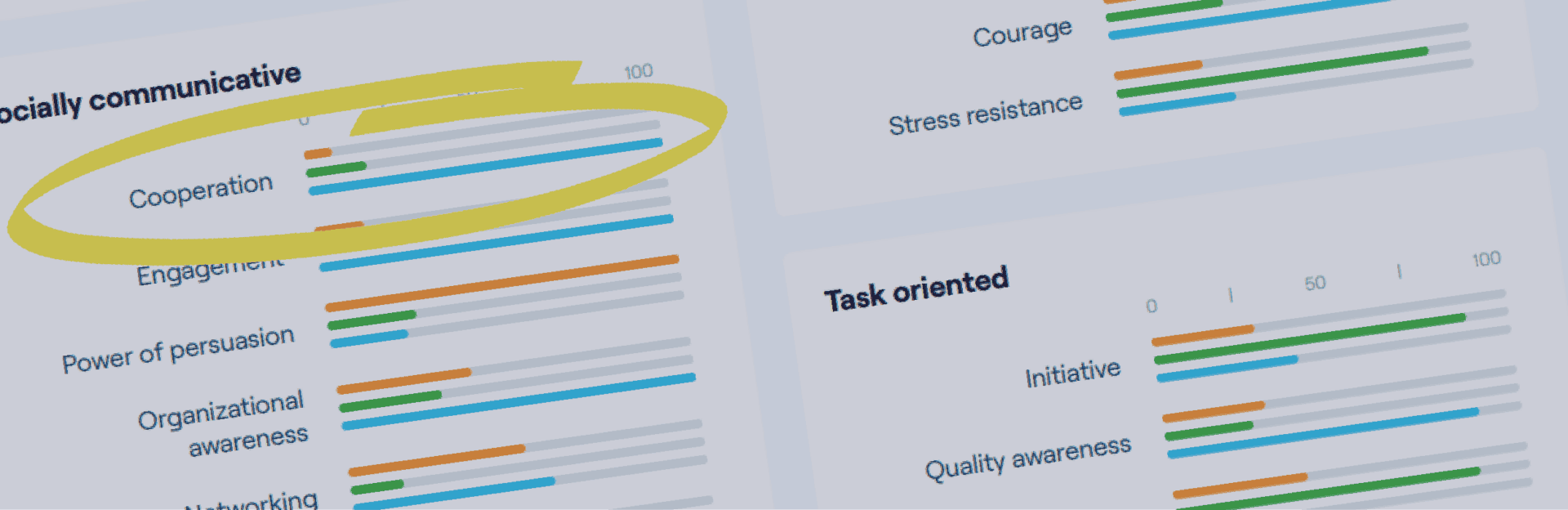
Competency 12: Cooperation
Cooperation is more than having friendly discussions or dividing tasks. It is the behavioural competency through which people connect information, effort and responsibility to a shared goal. The essence is mutual interdependence: strong individual work only becomes a shared result when people contribute reliably, align proactively, discuss differences and make room for one another’s expertise.
In this article
A recognisable workplace situation
A project team is working on a proposal with a tight deadline. Everyone completes their own part on time. During the final review, however, it becomes clear that analyses are based on different assumptions, a client conversation was not documented and no one owns the final quality check. The atmosphere is good, but the overall result falls short.
Strong individual work is not yet effective cooperation.
Cooperation is therefore not only about helping. It is also about sharing information in time, recognising dependencies, discussing differences and taking responsibility for the whole.
What is cooperation?
Nieuwenhuis defines cooperation as the willingness and ability to work with others towards a common goal, even when that goal is not of immediate personal interest. At the operational level, it is about contributing and informing. At the tactical level, cooperation becomes proactive: people ask for and offer help, make measurable agreements and incorporate one another’s perspectives. At the strategic level, the focus shifts towards encouraging knowledge sharing, feedback and strong working relationships (Nieuwenhuis, 2010).
Collegiality supports this competency through trust, openness to criticism and making use of people’s strengths, but it is not the same thing. A team can function pleasantly on a social level and still share too little information or organise responsibility poorly.
Cooperation connects individual contributions, mutual alignment and shared responsibility to one goal.
Role, skill or behavioural competency?
Job vacancies often ask for a collegial team player. That is too broad: friendliness says little about behaviour when interests clash, information is missing or agreements are not kept.
Not just a role
Being a team member is a position. Cooperation becomes visible in what someone does from that position.
Not just a social skill
Listening, giving feedback and handling conflict are important skills, but they only create value when they contribute repeatedly to the shared goal.
A behavioural competency
Cooperation combines knowledge, skills, attitude and choices. The competency is reflected in recurring behaviour: sharing information, asking for help, keeping agreements, making use of differences and taking responsibility. For HR, it is therefore more useful to define the required behaviour for each role than to label someone broadly as a strong or weak team player.
Scientific foundation
Research treats cooperation as a bundle of team processes, including aligning goals, coordinating, supporting, exchanging information and adjusting. A meta-analysis by LePine et al. (2008) shows positive relationships with team performance and satisfaction, depending in part on team size and task interdependence.
Sharing and integrating information
Mesmer-Magnus and DeChurch (2009) combined 72 studies involving 4,795 groups and approximately 17,279 participants. Information sharing was positively related to performance, cohesion, decision satisfaction and knowledge integration; the corrected relationship with team performance was approximately ρ = .42. More communication is not automatically better: teams need to actively invite and process unique knowledge.
Psychological safety and dissent
Psychological safety creates room to report mistakes, ask for help and express differing viewpoints. The meta-analysis by Frazier et al. (2017) included 136 independent samples, more than 22,000 individuals and nearly 5,000 groups and found relationships with learning, behaviour and performance. Safety is not the same as harmony: De Dreu and Weingart (2003) found negative relationships between task and relationship conflict and both performance and satisfaction. Differences therefore need to be addressed early, safely and in a task-focused way.
Knowing who knows what
Teams need shared goals, roles and ways of working, and they need to know where expertise is located. Shared mental models are positively associated with team processes and performance (DeChurch & Mesmer-Magnus, 2010). For transactive memory systems, a meta-analysis across 44 studies and 103 effect sizes found an average relationship with team outcomes of r = .44 (Fausett et al., 2026).
That final study also shows why measurement method matters. The relationship was stronger for self-reporting (r = .77) than for observations (r = .38) or embedded performance measures (r = .39). Cooperation should therefore not be assessed solely on what people say about themselves or their team.
A team only makes use of its knowledge when members know what others need, feel able to share unique information and actually incorporate that information into decisions.
Cooperation can also be developed. Meta-analyses of team training and collective reflection show positive effects, with intervention type, team size, team duration and measurement method all making a difference (Salas et al., 2008; Leblanc et al., 2024).
Why this competency has such impact
Much work is interdependent. A handover, software release or client implementation can fail even when every individual works competently. Team processes are also associated with performance, satisfaction and perceived team effectiveness (LePine et al., 2008). For leaders, cooperation therefore becomes a system question: do goals, decision rights, resources and feedback support the shared result?
The competency operates within a network
Closely related
Empathy, communication skills and engagement directly affect understanding, exchange and shared responsibility.
Supporting
Integrity, self-confidence, courage and stress resilience help people remain reliable, take a position and make tension discussable.
Enabling action
Decisiveness, initiative, results orientation, and planning and organising turn alignment into choices, agreements and progress.
This interaction prevents conclusions based on a single score. Empathy does not automatically lead to information sharing, and decisiveness can bypass expertise within the team. Development therefore connects qualities that are already visible.
The three levels of cooperation
Nieuwenhuis distinguishes three levels. The operational level is about contributing and informing. The tactical level focuses on proactively working with others towards a shared result. The strategic level focuses on encouraging cooperation, knowledge sharing, feedback and strong working relationships.
Operational
Contributing, informing and providing reliable input.
Tactical
Proactively aligning and connecting individual contributions.
Strategic
Creating conditions that enable others to collaborate sustainably.
The levels are not a ladder from insufficient to excellent. They describe different types of behaviour. The combination required depends on the task, role and context.
Each level explained in detail
Operational
Operational cooperation is visible in day-to-day behaviour: showing interest, helping when asked, keeping agreements, sharing information and exchanging views. The shared goal remains the guiding principle.
Key strength
Reliability. Team members know what contribution they can expect and receive information before dependencies become blocked.
Relevant pitfall
Contributing can remain reactive, causing the team to receive signals too late. Constantly helping can also put one’s own responsibilities under pressure.
Practical example
An employee discovers that an analysis will be completed later than agreed. She reports this immediately, explains which activities are affected, asks what priority the team needs and agrees on a new delivery date.
Tactical
Tactical cooperation is proactive: asking for and offering help, making measurable agreements, exchanging knowledge and visibly incorporating perspectives into plans and ways of working.
Key strength
Alignment. Roles, information, pace and decisions are connected so that different contributions complement one another.
Relevant pitfall
Alignment can become discussion without ownership. It therefore needs to result in decisions, responsibilities and follow-up moments.
Practical example
An HR adviser designs a new onboarding process with recruitment, IT and line management. She asks each party to identify dependencies and risks, agrees on decision making and checks after two weeks where handovers are still going wrong.
Strategic
Strategic cooperation encourages knowledge sharing, feedback and strong working relationships. It embeds cooperation in leadership, structure and culture so that it becomes less dependent on incidental personal effort.
Key strength
Cooperative capability becomes scalable. Shared goals, decision rights, feedback and knowledge sharing are designed so that multiple teams or organisations can contribute.
Relevant pitfall
Without concrete behaviour, time, authority and consequences, the vision remains a cultural promise.
Practical example
A senior management team links a value-chain goal to shared budgets, agrees on decision rights and organises monthly reviews in which departments share both results and mistakes and bottlenecks.
The three levels reinforce one another
Operational behaviour provides contributions and signals, tactical alignment connects them and strategic design makes repetition possible. Without execution, strategy remains an intention; without coordination, contributions become fragmented. No single person needs to master all levels, but the team does need to organise them.
Balance prevents imbalance
Operational helpfulness without agreements can lead to overload, tactical alignment without execution becomes endless discussion and strategic language without choices creates cynicism.
Mature cooperation does not require three maximum scores, but recognition of what the situation needs and who can provide which behaviour.
Effective use starts with the right match
The required form depends on role and context.
Operational strength
In operational teams, reliable day-to-day contribution carries significant weight: keeping agreements, sharing information in time, asking for help and handing over safely.
Tactical strength
In project, advisory and value-chain roles, dependencies are greater. It becomes important to connect roles, align interests and integrate knowledge from multiple disciplines.
Strategic strength
In senior management, leadership and organisational development, the emphasis is on shared goals, decision making, psychological safety and cooperation across team and organisational boundaries.
Low visibility at one level does not mean inability. The right match starts with the task and context, not with the highest possible score.
Why organisations often assess cooperation incorrectly
Organisations often confuse cooperation with friendliness, visibility or agreement. Speaking a lot and dividing tasks quickly can look decisive, while asking questions, sharing unique information or challenging an unrealistic agreement may be experienced as difficult. Yet that second type of contribution may be more important.
More cooperation is not always better either. Excessive alignment can dilute responsibility, slow the pace and make expertise dependent on consensus. Effective cooperation also means acting individually when appropriate.
A pleasant group exercise also provides no complete proof. CIPD (2024) recommends structured criteria, multiple assessors and realistic skills tasks. Assess information sharing, asking for help, incorporating perspectives, ownership and follow-up separately.
Social ease is not a reliable overall measure of cooperation.
Why this competency matters now
The competency of cooperation is becoming more relevant as work is increasingly hybrid, skills-based and carried out by both people and AI systems. The Future of Jobs Report 2025 expects 39% of existing skill sets to change by 2030; 63% of employers identify skill gaps as a barrier to transformation and 85% prioritise upskilling. The report does not measure cooperation separately, but it does underline the importance of human skills alongside technology (World Economic Forum, 2025).
In the Netherlands, 80% of companies with at least ten employees offered remote working in 2025; 61% of employees were able to make use of it (CBS, 2026a). Hybrid work requires explicit agreements about presence, meetings, coordination and connection (Eurofound, 2025).
74%
Of Dutch self-employed professionals without employees, 74% collaborated with other self-employed professionals at least occasionally in 2025; 30% did so often or always (CBS, 2026b).
In temporary projects, value chains and networks too, expectations and responsibilities need to be aligned without an obvious hierarchy.
In 2026, Microsoft surveyed 20,000 working AI users across ten countries. Advanced users more often reported exploring AI together (63% versus 32%) and sharing lessons and mistakes (61% versus 36%). Repeatable agreements about agent workflows, handovers and quality remained limited: 26% versus 19%. This self-reported corporate research shows association, not causality (Microsoft, 2026).
CompetentNL was launched in September 2025 as a national skills language (Government of the Netherlands, 2025). Of 1,271 recruitment professionals surveyed by LinkedIn, 93% consider accurate skills assessment crucial. Organisations with the highest number of skills-based searches on the platform were 12% more likely to be linked to a high-quality hire. This is an association, not a causal effect (LinkedIn, 2025).
Work design matters too. Based on PIAAC 2023, the OECD (2026) finds that cooperative skills are widely used in nearly all countries studied, but can remain underused when work design and management provide insufficient room for them.
At the same time, this competency is under pressure
Digital fragmentation reduces visibility of information, hybrid work reduces spontaneous alignment and AI can blur ownership. High workloads also reward rapid individual action.
Technology expands the possibilities for cooperation, but it does not replace a shared goal, clear role allocation or mutual accountability.
Why self-insight makes a difference
A profile score only gains meaning in relation to concrete behaviour, role, context and consequences. One person contributes by executing reliably, another by aligning and a third by designing the system.
An example: from profile to development direction
In the profile of a 21-year-old student, cooperation is visible at 17% operationally, 17% tactically and 100% strategically. This is not a judgement about talent or collegiality, but a hypothesis: strategic behaviour is strongly visible, while day-to-day contribution and process alignment are less so.
Operational
Tactical
Strategic
Test this against behaviour: do I share information proactively, ask for help, make agreements measurable and continue contributing when the process becomes difficult? Opportunity matters too. Someone who has mainly worked independently may have had fewer opportunities to show cooperative behaviour.
Other competencies can provide potential bridges. Operational empathy (100%) and integrity (88%) support attentiveness and reliability. At the tactical level, communication skills, initiative and stress resilience are each 100% visible, self-confidence 89% and decisiveness 86%. They only compensate for a lower score when they lead to concrete alignment, addressing issues and follow-up.
Personality shapes the natural style
Personality types provide reflection questions, but do not predict a score or performance. Meta-analyses find only small or weak relationships between personality traits and team performance, depending on context and composition (Peeters et al., 2006; Han et al., 2024). A Perfectionist brings quality and practises letting go; a Helper aligns with others while protecting their own position; an Achiever brings results focus while making room for the process; an Individualist adds originality while staying connected despite differences. An Observer shares analyses in time; a Loyalist sometimes acts without complete certainty; a Leader allows others to exert influence; a Mediator also takes a position themselves; an Enthusiast persists when execution is less inspiring.
For an Enthusiast with Helper as self-image, the question to explore is whether enthusiasm and care remain visible in situations involving repetition, boundaries or dissent. This does not explain the scores, but it is a testable hypothesis.
Learning styles can guide development
Learning styles also provide a language for reflection. The Accommodator asks for feedback on alignment after taking action, the Diverger voices observations earlier, the Assimilator translates insight into a team agreement and the Converger ends each meeting with an action, owner, deadline and review point.
Fixed matching of learning to a learning style is insufficiently supported by evidence. A meta-analysis of 21 studies, 101 effect sizes and 1,712 participants found support for the matching hypothesis in only about a quarter of the outcomes (Clinton-Lisell & Litzinger, 2024). The Converger learning style therefore does not explain the score pattern, but it can help make a practice format more practical.
The relationships between competencies are broadly recognisable, but the specific combination is personal. A profile is the starting point for exploration, not the end point of a judgement.
What this means for organisations
For recruitment, the competency of cooperation starts with job analysis. Replace the requirement “team player” with behavioural criteria and use structured interviews, work samples and simulations involving information sharing, aligning dependencies and responding to dissent.
- Recruitment: assess contribution, alignment and the creation of conditions for cooperation separately.
- HR and managers: develop behaviour in real work processes and also examine roles, safety and information provision.
- Senior management: organise goals, decision rights, resources and feedback across departmental boundaries.
Development does not automatically mean communication training. When information does not make it into decisions, process design may be the problem; when mistakes are concealed, psychological safety is relevant; when agreements disappear, ownership and follow-up are needed. Team managers can therefore separately observe who contributes information, asks for help, processes dissent and follows up decisions. Senior management needs to organise shared goals, time, incentives and authority across organisational boundaries.
How Voice Your Future makes cooperation visible
Voice Your Future makes the competency of cooperation visible through its distribution across operational, tactical and strategic behaviour. This enables a more precise conversation about visible behaviour and what a role or team requires.
- Where is cooperation visible?
- Which related competencies support the behaviour?
- Which context supports or hinders the translation into behaviour?
The profile formulates hypotheses that are tested against experiences and observations. A low score does not mean inability and a high score does not guarantee effectiveness. The value lies in connecting score, behaviour, context and development for individuals, teams and organisations.
The essence of cooperation
Cooperation connects information, effort and responsibility to a shared goal. Operationally, it is about contributing and informing; tactically, about alignment and integrating knowledge; strategically, about creating conditions for cooperation, learning and accountability.
The strength of cooperation does not lie in doing as much as possible together. It lies in creating exactly enough connection for individual qualities to become a shared result.
References
Scientific, societal and business sources used.
Statistics Netherlands. (2026a, 10 februari). Remote working unchanged since 2022. https://www.cbs.nl/nl-nl/nieuws/2026/07/werken-op-afstand-onveranderd-sinds-2022
Statistics Netherlands. (2026b). Do self-employed professionals use networks or other self-employed professionals? https://www.cbs.nl/nl-nl/faq/zzp/gebruiken-zzp-ers-netwerken-of-andere-zzp-ers-
Chartered Institute of Personnel and Development. (2024, 11 november). Selection methods. https://www.cipd.org/uk/knowledge/factsheets/selection-factsheet/
Clinton-Lisell, V., & Litzinger, C. (2024). Is it really a neuromyth? A meta-analysis of the learning styles matching hypothesis. Frontiers in Psychology, 15, Article 1428732. https://doi.org/10.3389/fpsyg.2024.1428732
DeChurch, L. A., & Mesmer-Magnus, J. R. (2010). Measuring shared team mental models: A meta-analysis. Group Dynamics: Theory, Research, and Practice, 14(1), 1-14. https://doi.org/10.1037/a0017455
De Dreu, C. K. W., & Weingart, L. R. (2003). Task versus relationship conflict, team performance, and team member satisfaction: A meta-analysis. Journal of Applied Psychology, 88(4), 741-749. https://doi.org/10.1037/0021-9010.88.4.741
Eurofound. (2025). The hybrid workplace: Ensuring benefits for workers and organisations. Publications Office of the European Union. https://doi.org/10.2806/7897416
Fausett, C. M., Keebler, J. R., Lazzara, E. H., Gregory, M., & Blickensderfer, E. (2026). Measurement matters: A meta-analytic examination of transactive memory systems and team outcomes. Small Group Research. Advance online publication. https://doi.org/10.1177/10464964261434540
Frazier, M. L., Fainshmidt, S., Klinger, R. L., Pezeshkan, A., & Vracheva, V. (2017). Psychological safety: A meta-analytic review and extension. Personnel Psychology, 70(1), 113-165. https://doi.org/10.1111/peps.12183
Han, A., Krieger, F., Kim, S., Nixon, N., & Greiff, S. (2024). Revisiting the relationship between team members’ personality and their team’s performance: A meta-analysis. Journal of Research in Personality, 112, Article 104526. https://doi.org/10.1016/j.jrp.2024.104526
Leblanc, P.-M., Harvey, J.-F., & Rousseau, V. (2024). A meta-analysis of team reflexivity: Antecedents, outcomes, and boundary conditions. Human Resource Management Review, 34(4), Article 101042. https://doi.org/10.1016/j.hrmr.2024.101042
LePine, J. A., Piccolo, R. F., Jackson, C. L., Mathieu, J. E., & Saul, J. R. (2008). A meta-analysis of teamwork processes: Tests of a multidimensional model and relationships with team effectiveness criteria. Personnel Psychology, 61(2), 273-307. https://doi.org/10.1111/j.1744-6570.2008.00114.x
LinkedIn. (2025). The future of recruiting 2025. https://business.linkedin.com/hire/resources/future-of-recruiting
Mesmer-Magnus, J. R., & DeChurch, L. A. (2009). Information sharing and team performance: A meta-analysis. Journal of Applied Psychology, 94(2), 535-546. https://doi.org/10.1037/a0013773
Microsoft. (2026). 2026 Work Trend Index annual report: Agents, human agency, and the opportunity for every organization. https://www.microsoft.com/en-us/worklab/work-trend-index/agents-human-agency-and-the-opportunity-for-every-organization
Nieuwenhuis, M. A. (2010). The art of management. Accessed via 123management.nl.
Organisation for Economic Co-operation and Development. (2026). How workers use, or don’t use, their skills in the workplace. OECD Publishing. https://doi.org/10.1787/0e7c6dc9-en
Peeters, M. A. G., Van Tuijl, H. F. J. M., Rutte, C. G., & Reymen, I. M. M. J. (2006). Personality and team performance: A meta-analysis. European Journal of Personality, 20(5), 377-396. https://doi.org/10.1002/per.588
Government of the Netherlands. (2025, 24 september). The Netherlands gets a national standard for describing skills. https://www.rijksoverheid.nl/actueel/nieuws/2025/09/24/nederland-krijgt-een-nationale-standaard-om-vaardigheden-te-beschrijven
Salas, E., DiazGranados, D., Klein, C., Burke, C. S., Stagl, K. C., Goodwin, G. F., & Halpin, S. M. (2008). Does team training improve team performance? A meta-analysis. Human Factors, 50(6), 903-933. https://doi.org/10.1518/001872008X375009
World Economic Forum. (2025). The Future of Jobs Report 2025. https://www.weforum.org/publications/the-future-of-jobs-report-2025/digest/

