Organisational awareness
Understanding what happens behind the visible structure.
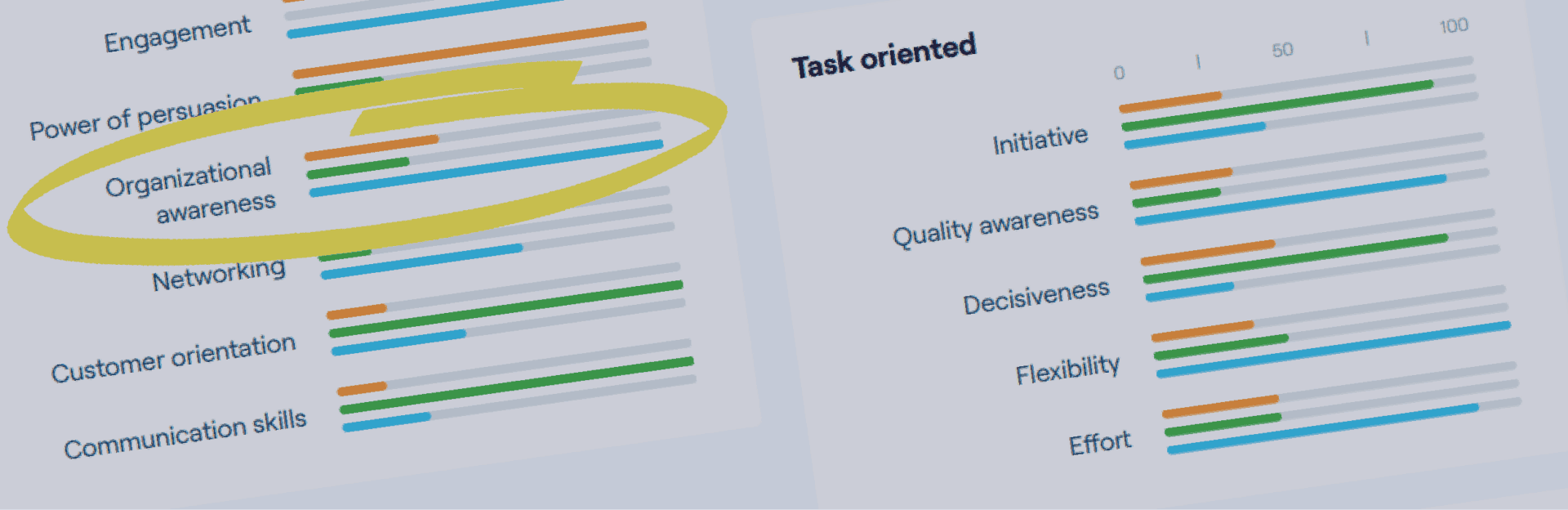
Competency 10: Organizational awareness
Organizational awareness is not simply knowing what the organizational chart looks like. It is about seeing how people, interests, values, relationships, decision-making and external developments combine to determine what is possible within an organization.
In this article
A recognizable situation at work
A project manager presents a carefully substantiated proposal to the management team. The analysis is sound, the planning is feasible and the financial implications have been calculated. Yet no decision is made. The formal owner of the topic responds positively, but an experienced department manager asks a few cautious questions. Another manager remains silent. After the meeting, the proposal slowly disappears from the agenda.
There appears to be little wrong with the content. From an organizational perspective, a great deal has been missed. The project manager did not know that an earlier reorganization was still a sensitive issue, that two departments were competing for the same capacity and that the silent manager held considerable informal influence. It was also unclear that new legislation would make the topic much more urgent within a few months.
This is the domain of organizational awareness. The competency is not simply about knowing what the organizational chart looks like. It is about seeing how people, interests, values, relationships, decision-making and external developments combine to determine what is possible within an organization. Someone who acts with organizational awareness understands not only the formal route, but also the context that gives that route meaning.
What is organizational awareness?
Within Nieuwenhuis’s competency model, organizational awareness is a behavioural competency that can be demonstrated at operational, tactical and strategic level (Nieuwenhuis, 2010). At operational level, a person adapts to the organization’s norms and values. At tactical level, a person considers the consequences of internal developments. At strategic level, the consequences of social and political developments for the organization are taken into account.
These levels describe a movement from near to far. It starts with what happens in the immediate working environment. Attention then shifts to interests, dependencies and developments within the organization. Finally, the outside world comes into view: how do politics, society, technology, the economy and the labour market change the space in which the organization operates?
In scientific literature, organizational awareness is not a uniformly defined construct. The Emotional and Social Competency Inventory places it under social awareness and describes it as reading emotional currents, power relationships, influencers, networks and group dynamics (Korn Ferry, 2017). This description mainly covers the operational and tactical levels. Systems thinking and environmental scanning are also relevant to the strategic level. Organizational awareness is therefore best understood as the ability to notice what is happening, understand why it is happening, anticipate how the context may develop and adapt one’s actions accordingly.
A role, skill or behavioural competency?
Organizational awareness is neither a role nor a stand-alone technique. It is a behavioural competency in which knowledge, attitude, observation, interpretation and action come together.
Role
Organizational awareness is not a role. The form and level required do, however, depend on a person’s position, responsibilities and environment.
Skill
Knowledge of structure, culture and processes helps, but knowing the organizational chart does not mean someone understands how decisions are really made.
Behavioural competency
Knowledge, attitude, observation, interpretation and action combine in recurring behaviour within a specific organizational context.
Organizational awareness is neither a role nor a stand-alone technique. It is a behavioural competency in which knowledge, attitude, observation, interpretation and action come together. Knowledge of structure, culture and processes helps, but someone may know the organizational chart by heart and still fail to understand how a decision is really made. Conversely, someone may be highly attuned to informal relationships but struggle to test those observations carefully or turn them into effective behaviour.
The competency therefore consists of a chain. Sensitivity and environmental awareness help a person notice relevant signals. Listening and problem analysis support the gathering and organization of information. Judgement is needed to weigh interests and consequences carefully. Flexibility helps adapt the approach to the context. Initiative, persuasiveness, collaboration, planning and organizing then turn insight into action.
The connections between these competencies are generally recognizable. Their specific expression is personal. One employee primarily reads emotions and tension. Another understands structures and processes. A third quickly identifies which people are needed to achieve results. Organizational awareness does not arise from one ideal personality, but through different routes, each with its own strengths and blind spots.
Scientific foundation
Organizational socialization and fit
The operational level connects with research into organizational socialization and person-organization fit. New employees need to learn which roles, expectations and ways of interacting apply, as well as how to become a social part of the organization. A recent meta-analysis of 256 studies shows that social acceptance, role clarity, task mastery and perceived fit are associated with job satisfaction, engagement, performance, well-being and intention to stay. In this analysis, social acceptance was relatively strongly associated with job satisfaction, organizational commitment, performance and well-being (Bauer et al., 2025).
Research into person-organization fit likewise shows that alignment with an organization’s values and characteristics is primarily related to work attitudes, commitment and turnover. The relationship with performance is less clear-cut (Kristof-Brown et al., 2005). A good fit can therefore contribute to connection, but does not guarantee that someone will perform their role more effectively.
This distinction matters. Operational organizational awareness does not mean adapting uncritically. Someone who follows every existing norm may suppress valuable dissenting information. Effective behaviour requires a person to recognize the context and then consciously choose how to respond.
Political skill and social effectiveness
The tactical level touches on the research tradition surrounding political skill. This literature generally distinguishes social astuteness, interpersonal influence, networking ability and apparent sincerity. In this context, political skill does not automatically mean manipulation. It concerns understanding other people at work and using that knowledge effectively for personal or organizational goals.
A meta-analysis by Munyon et al. (2015) shows that political skill is positively associated with self-efficacy, job satisfaction, organizational commitment, productivity, positive behaviour beyond formal duties, career success and reputation. It also predicted task performance beyond personality traits and general cognitive ability. Another meta-analysis found positive relationships with both task performance and contextual performance. The relationship with task performance became stronger as roles involved more social and interpersonal demands (Bing et al., 2011).
Simply identifying who has influence is not enough. In Munyon et al.’s research (2015), networking ability, interpersonal influence and apparent sincerity predicted task performance, while social astuteness alone was not a clear predictor. Observation only gains organizational value when someone carefully translates it into relationships, alignment and action.
Systems thinking and environmental scanning
Strategic organizational awareness requires the ability to zoom out. Systems thinking helps identify relationships, feedback loops, delays and unintended consequences. A systematic review of organizational applications shows that systems thinking can contribute to learning, analysis, planning and addressing complex issues. Combining different perspectives and involving practitioners are important conditions (Bui & Galanou, 2022).
Environmental scanning focuses on systematically collecting and interpreting signals from the outside world. It can support scenario development, innovation and strategic change. Robinson et al. (2021) show in their review that the literature in this area is broad and fragmented. Collecting more information does not automatically produce better performance. Value arises when signals are interpreted, shared and connected to decision-making.
Observation only gains organizational value when someone carefully translates it into relationships, alignment and action.
Why this competency has such an impact
Organizations are both social and administrative systems.
Organizational awareness increases the likelihood that expertise will have a real impact.
For leaders, the impact is particularly significant because formal authority is rarely enough.
Organizations are both social and administrative systems. A well-founded decision can stall when interests are ignored, the wrong people are involved too late or consequences for other departments are overlooked. Conversely, a mediocre proposal may gain momentum because someone builds the right coalition. Organizational awareness therefore affects not only what someone sees, but also how much impact their expertise ultimately has.
The relationship with happiness at work is probably mainly indirect. A person who better understands implicit expectations, social relationships and interests may experience greater control and clarity. Meta-analytic research shows that political skill is associated with fewer general work stressors, less role conflict, less role ambiguity and less burnout, although not every type of strain showed a consistent relationship (Summers et al., 2020). Organizational awareness is therefore no guarantee against stress. It can, however, help people recognize certain organizational stressors earlier and make them more manageable.
The impact is especially significant for leaders. Formal authority is rarely enough to bring about change. Leaders need to understand where influence lies, which groups experience support or resistance, and how history and culture shape responses to decisions. In field research, employees’ perceptions of their leaders’ political skill predicted rated leadership effectiveness beyond demographic characteristics and other social skills (Douglas & Ammeter, 2004).
Why organizations often assess this competency incorrectly
Organizational awareness is difficult to observe because an important part of the competency occurs before visible action. The employee observes, connects signals, tests assumptions and chooses a route. Only the final behaviour is visible.
This creates several assessment errors. Having many contacts may be mistaken for having a strong network. Confident language may be seen as influence. Long tenure may be confused with broad organizational knowledge. Compliant behaviour may appear to be adaptability when it could also be conflict avoidance. Critical independence, meanwhile, may incorrectly be judged as insufficient organizational awareness.
Self-reporting also has limitations. The ESCI technical manual emphasizes that self-assessments are mainly a basis for development conversations and that different assessors observe behaviour in different situations (Korn Ferry, 2017). For selection and development, it is therefore sensible not merely to ask people what they think about themselves, but to explore specific situations, observed behaviour, choices and effects.
Political skill also deserves an ethical test. It can support collaboration, but can also be used for personal advantage. In a multi-source study, Zahid et al. (2025) found that political skill was indirectly associated with self-serving counterproductive behaviour under certain conditions. Organizational awareness is therefore mature only when contextual acuity is combined with integrity and responsibility.
Organizational awareness is mature only when contextual acuity is combined with integrity and responsibility.
The three levels of organizational awareness
The three levels are not a hierarchy in which strategic is always better. They describe different distances from the context. The combination required depends on the role, responsibilities and environment.
The three levels are not a hierarchy in which strategic is always better. They describe different distances from the context.
Operational
Central movement
Reading the immediate working environment and taking norms and values into account.
Tactical
Central movement
Understanding interests, dependencies and internal developments.
Strategic
Central movement
Connecting the organization with its social and political environment.
The levels work like a zoom function, moving from concrete signals in daily practice to internal patterns and the broader developments in which the organization operates.
Operational organizational awareness
Operational organizational awareness is the ability to read the immediate working environment and take the organization’s norms and values into account. A person notices how people interact, which expectations apply implicitly and who has influence in a particular situation.
What does this behaviour look like?
Recognizes formal and unwritten rules.
Senses which tone and approach fit the situation.
Knows where to find practical information or permission.
Considers the direct consequences of their actions for colleagues.
Adapts the approach without losing sight of the goal.
Potential pitfalls
Strong operational awareness can turn into excessive adaptation. A person may become so focused on what the existing culture accepts that dissenting signals or new ideas receive less space. Another pitfall is remaining too close to the immediate situation and failing to investigate the interests or developments behind it.
Practical example
A new recruiter notices that hiring managers formally say speed is important, but mainly seek certainty in their conversations. She adjusts her consultation: instead of simply presenting candidates faster, she makes the risks associated with each profile explicit in advance. This enables her to respond more effectively to the real need without bypassing the formal process.
Tactical organizational awareness
Tactical organizational awareness concerns interests, dependencies and internal developments. A person looks beyond what people say or do and tries to understand why they take a particular position, which groups depend on each other and how decisions affect other parts of the organization.
What does this behaviour look like?
Maps stakeholders and their interests.
Recognizes formal and informal influence.
Sees dependencies between teams, processes and decisions.
Builds relationships and support in good time.
Connects proposals to broader organizational goals.
Remains credible while moving between different perspectives.
Potential pitfalls
The first pitfall is naivety: assuming that a well-founded proposal will be adopted automatically. The second is the opposite: treating every contact purely as a political instrument. When relationships feel instrumental or insincere, trust disappears. Tactical effectiveness therefore requires both insight and apparent sincerity.
Practical example
A team manager wants to introduce a new planning system. Instead of immediately requesting a decision, she first speaks with employees, IT, finance and an influential senior planner. She discovers that the resistance is not directed at the system itself, but at the loss of local discretion. The proposal is adapted to include clear options for exceptions. This creates support without abandoning the organizational goal.
Strategic organizational awareness
Strategic organizational awareness connects the organization with its social and political environment. A person follows external developments, assesses their possible significance and understands how they may affect legitimacy, direction, structure, people and resources over the longer term.
What does this behaviour look like?
Follows relevant political, economic, social and technological developments.
Recognizes early signals and structural patterns.
Explores several possible future scenarios.
Thinks in terms of interdependencies and unintended consequences.
Connects external developments to people, organizational and strategic choices.
Makes uncertainty open for discussion without creating false certainty.
Potential pitfalls
Strategic thinking can remain abstract. An analysis of trends has little value if it is not translated into choices, ownership and action. A second pitfall is presenting forecasts as certainty. Environmental scanning and scenarios are specifically intended to test assumptions and explore different futures.
Practical example
A healthcare organization does not see population ageing merely as a future capacity issue. It connects demographic data with labour shortages, technological support, changing client expectations and the mental burden on employees. The result is not a stand-alone recruitment campaign, but an integrated direction for technology, work allocation, training and regional collaboration.
The three levels reinforce one another
The levels work like a zoom function. Operational awareness provides concrete signals from daily practice. Tactical awareness connects those signals to interests and internal patterns. Strategic awareness places those patterns within a broader development.
Without operational observation, strategy can become detached from reality. Without tactical interpretation, signals remain fragmented. Without a strategic perspective, the organization primarily responds to what is already visible. Mature organizational awareness therefore moves between the levels: close enough to understand practice and sufficiently zoomed out to choose a direction.
Closeness and distance
Mature organizational awareness moves between the levels: close enough to understand practice and sufficiently zoomed out to choose a direction.
Effective use starts with the right match
An employee in a clearly defined operational role mainly benefits from operational organizational awareness. A project manager or HR adviser more often needs to look across departments and interests. Directors, policymakers and people responsible for change also require strategic awareness.
This means organizations should not automatically seek the highest possible score. They need to determine which behaviour the role requires, in which situations it needs to be demonstrated and which other competencies are needed to turn insight into results. The right match is not about maximum organizational awareness, but appropriate organizational awareness.
The right match is not about maximum organizational awareness, but appropriate organizational awareness.
Demand for this competency is growing
The term organizational awareness does not always appear literally in labour market reports. Its building blocks are clearly visible, however. In the Future of Jobs Report 2025, 69% of surveyed employers identify analytical thinking as a core skill, 67% resilience and flexibility, 61% leadership and social influence, 50% empathy and active listening, and 42% systems thinking. According to the employers surveyed, almost 40% of required skills will change by 2030 (World Economic Forum, 2025).
Dutch employers likewise expect economic, technological and demographic developments to have an impact. According to the 2024 Netherlands Employers Work Survey, almost half systematically consider the future of work. Large establishments do so more often than small ones (Kraan et al., 2025). Organizational awareness is therefore not only important for executives. HR, recruitment, team management and professionals also need to connect signals from the outside world to their own organization.
European frameworks emphasize the same movement. GreenComp includes systems thinking, futures literacy, adaptability and action (Bianchi et al., 2022). The managers’ competency framework of the General Secretariat of the Council of the European Union asks managers to follow political, technological, economic, social, legal and organizational developments, assess their consequences and recognize underlying sensitivities (General Secretariat of the Council, 2024).
Companies are increasingly organizing this capability explicitly. For its Logistics Trend Radar, DHL combines the perspectives of employees, customers, start-ups, research partners and experts, translating forty social, business and technological trends into their expected impact and adoption time (DHL, 2024). Shell uses scenarios to explore alternative business environments and test strategic assumptions. The energy scenarios published in 2025 connect energy security, artificial intelligence and the energy transition without presenting the scenarios as forecasts (Shell, 2025).
At the same time, this competency is under pressure
The same developments that make organizational awareness more important also make it more difficult. Hybrid work reduces incidental observation and informal contact. Reorganizations change networks and responsibilities. Artificial intelligence speeds up information processing, but can create the impression that more data automatically leads to better understanding. Geopolitical and technological changes follow one another more rapidly, while time for reflection remains scarce.
Labour shortages also change the context. UWV reports that employers are more frequently relaxing job requirements and providing more training to new employees. In research among 2,300 employers, 56% made concessions on work experience and 46% on skills. Of the employers who hired people who did not yet meet all the requirements, 74% offered training, compared with 53% in 2021 (UWV, 2025). This makes it more important not to treat organizational knowledge as a self-evident entry requirement, but to develop it consciously.
Skills-first recruitment offers opportunities, but also creates a new assessment challenge. LinkedIn reports that 93% of surveyed recruitment professionals consider accurate skills assessment important to quality of hire. Organizations that searched most strongly for skills on the platform were more likely to report a high-quality hire (LinkedIn, 2025). For organizational awareness, this means replacing general impressions of cultural fit with concrete behavioural criteria and comparable practical situations.
Organizational knowledge should not be treated as a self-evident entry requirement, but developed consciously.
Why self-awareness makes the difference
Organizational awareness is shaped by what a person naturally notices. A people-oriented person may quickly see tension and interpersonal relationships, but underestimate business interests. An analytical person understands structures and decision-making processes, but may miss subtle social signals. An action-oriented person quickly knows who is needed to make something happen, but may act too soon. A cautious person recognizes risks and sensitivities, but may hesitate to turn that insight into action.
In an example profile of a woman working as a lifestyle coach, this personal distribution is pronounced: operational 100%, tactical 29% and strategic 25%. The case shows how strongly organizational awareness can operate close to the immediate situation. She quickly reads the immediate environment, influence and unwritten rules. Her development opportunity lies in connecting those signals more consciously to medium-term interests and longer-term external developments.
This woman’s analysis profile also shows a combination of Achiever as a personality type, an Individualist self-image and Thinker as a learning style. In her competency profile, results orientation and analytical processing support her sharp, goal-focused observation. Her emphasis on authenticity may make political navigation feel less natural or even insincere. The development question is not how she can become more calculating, but how she can act with awareness of interests without losing her own credibility.
This case illustrates the personal expression. Scientific literature helps us understand possible mechanisms and formulate development questions more precisely.
The connections between competencies are broadly recognizable, but their particular combination is personal. A score only gains meaning when it is connected to role, context, behaviour, consequences and direction of development.
What this means for organizations
For recruitment, it starts with a clear job analysis. Which level of organizational awareness is genuinely required? Which situations are characteristic? Which behaviours distinguish effective from ineffective action? A structured interview can ask candidates to describe a situation in which interests conflicted, a formal process proved insufficient or an external development affected the work. Asking candidates the same core questions and assessing their answers against predetermined behavioural criteria reduces the likelihood that style, familiarity or confidence will be mistaken for competency.
For HR, this means organizational awareness deserves attention beyond selection. Onboarding should help employees learn about both the formal and informal organization responsibly. Mentoring, internal projects, stakeholder analyses and mobility between teams provide access to perspectives that cannot be found in procedures. Research into organizational socialization shows that mentoring and support are associated with social acceptance, role clarity and task mastery (Bauer et al., 2025). A study among business students also found an association between having a mentor and political skill, although the research does not demonstrate a direct causal effect (Chopin et al., 2012).
Internal talent marketplaces can support this development. Schneider Electric reported that, by the end of 2023, more than 85% of employees had access to its Open Talent Market, offering visibility of roles, mentoring relationships and temporary projects. During that year, more than 15,000 positions were visible, around 4,000 mentoring relationships were established and approximately 3,000 employees worked on internal projects (Schneider Electric, 2023). Such experiences can broaden organizational knowledge by exposing employees to other roles, countries and interests. The figures were published by the company itself and do not independently demonstrate the programme’s effect on organizational awareness.
Team managers have an important responsibility to make context discussable. They should ask not only what has been decided, but also which interests were considered, who has not yet been heard and which consequences may arise elsewhere. For executive teams, the task is to organize constructive challenge, environmental scanning and scenario work. Strategic organizational awareness should not depend on one well-informed executive. It must become part of how information is collected, shared and connected to decisions.
For career coaching, the central question is not whether someone is or is not organizationally aware. It is more relevant to ask what the person notices easily, what remains outside their view and what next step is needed. For a sensitive employee, that may be acting. For an analytical employee, it may be including informal relationships. For a results-oriented employee, it may be slowing down and weighing consequences.
How Voice Your Future makes organizational awareness visible
Voice Your Future makes organizational awareness visible by looking beyond a single overall judgement to the distribution across operational, tactical and strategic levels and the connection with other competencies and personal patterns.
This distribution helps distinguish sensitivity to the immediate context, insight into internal interests and attention to social and political developments. The related competencies environmental awareness and sensitivity show which signals someone is likely to notice. Listening, problem analysis, judgement and flexibility provide insight into processing. Initiative, persuasiveness, collaboration, planning and organizing show how insight can be translated into action.
The profile report is therefore not a stand-alone label. It is a starting point for further self-exploration. The connections between competencies are broadly recognizable, but the specific combination is personal. A score only gains meaning when it is connected to role, context, behaviour, consequences and direction of development.
Notice
Environmental awareness and sensitivity show which signals someone is likely to notice.
Process
Listening, problem analysis, judgement and flexibility provide insight into how those signals are processed.
Act
Initiative, persuasiveness, collaboration, planning and organizing show how insight is translated into behaviour.
The essence of organizational awareness
Organizational awareness is understanding what happens behind the visible structure and acting responsibly in response. It starts with one’s own position, broadens to include other people and their interests, and ultimately extends to the organization as part of a changing society.
The competency requires both closeness and distance. Closeness is needed to recognize subtle signals, values and relationships. Distance is needed to understand patterns, dependencies and future consequences. It requires adaptation without losing yourself, influence without manipulation, and foresight without pretending that the future is fixed.
The essence is therefore not becoming politically clever. The essence is enabling content, people and context to genuinely meet. Someone who acts with organizational awareness sees more than the organizational chart, understands more than the stated position and uses that insight to make choices more effective, careful and future-ready.
References
This page is based on scientific literature, European frameworks and current professional sources concerning organizational socialization, political skill, systems thinking, environmental scanning, recruitment and organizational development.
Bauer, T. N., Erdogan, B., Ellis, A. M., Truxillo, D. M., Brady, G. M., & Bodner, T. (2025). New horizons for newcomer organizational socialization: A review, meta-analysis, and future research directions. Journal of Management, 51(1), 344–382. https://doi.org/10.1177/01492063241277168
Bianchi, G., Pisiotis, U., & Cabrera Giraldez, M. (2022). GreenComp: The European sustainability competence framework. Publications Office of the European Union. https://doi.org/10.2760/13286
Bing, M. N., Davison, H. K., Minor, I., Novicevic, M. M., & Frink, D. D. (2011). The prediction of task and contextual performance by political skill: A meta-analysis and moderator test. Journal of Vocational Behavior, 79(2), 563–577. https://doi.org/10.1016/j.jvb.2011.02.006
Bui, H. T. M., & Galanou, E. (2022). Translation of systems thinking to organizational goals: A systematic review. Journal of General Management, 47(4), 233–245. https://doi.org/10.1177/03063070211035749
Chopin, S. M., Danish, S. J., Seers, A., & Hook, J. N. (2012). Effects of mentoring on the development of leadership self-efficacy and political skill. Journal of Leadership Studies, 6(3), 17–32. https://doi.org/10.1002/jls.21253
Clinton-Lisell, V., & Litzinger, C. (2024). Is it really a neuromyth? A meta-analysis of the learning styles matching hypothesis. Frontiers in Psychology, 15, Article 1428732. https://doi.org/10.3389/fpsyg.2024.1428732
DHL. (2024). Logistics trend radar 7.0. https://www.dhl.com/content/dam/dhl/global/csi/documents/pdf/glo-csi-logistics-trend-radar-7-0.pdf
Douglas, C., & Ammeter, A. P. (2004). An examination of leader political skill and its effect on ratings of leader effectiveness. The Leadership Quarterly, 15(4), 537–550. https://doi.org/10.1016/j.leaqua.2004.05.006
General Secretariat of the Council. (2024). Competency framework for managers. Council of the European Union. https://www.consilium.europa.eu/media/nrehuprg/competency-framework-for-managers-booklet-a5_en-for-web.pdf
Korn Ferry. (2017). Emotional and social competency inventory: Research guide and technical manual. https://www.kornferry.com/content/dam/kornferry/docs/article-migration/ESCI_Technical_Manual_nav_04052017.pdf
Kraan, K. O., Hulsegge, G., Peijen, R., & Van der Torre, W. (2025). De toekomst van werk volgens werkgevers: Een representatief beeld van Nederland en de zorg uitgelicht (TNO 2025 R11138). TNO. https://repository.tno.nl/SingleDoc?docId=73019
Kristof-Brown, A. L., Zimmerman, R. D., & Johnson, E. C. (2005). Consequences of individuals’ fit at work: A meta-analysis of person-job, person-organization, person-group, and person-supervisor fit. Personnel Psychology, 58(2), 281–342. https://doi.org/10.1111/j.1744-6570.2005.00672.x
LinkedIn. (2025). The future of recruiting 2025. https://business.linkedin.com/content/dam/me/business/en-us/talent-solutions/resources/pdfs/future-of-recruiting-2025.pdf
Munyon, T. P., Summers, J. K., Thompson, K. M., & Ferris, G. R. (2015). Political skill and work outcomes: A theoretical extension, meta-analytic investigation, and agenda for the future. Personnel Psychology, 68(1), 143–184. https://doi.org/10.1111/peps.12066
Nieuwenhuis, M. A. (2010). The art of management 1: Strategie en structuur (10e druk). M. Nieuwenhuis. ISBN 978-90-806665-1-1.
Robinson, C. V., Ahmad, F., & Simmons, J. E. L. (2021). Consolidation and fragmentation in environmental scanning: A review and research agenda. Long Range Planning, 54(3), Article 101997. https://doi.org/10.1016/j.lrp.2020.101997
Schneider Electric. (2023). 2023 human resources report. https://www.se.com/ww/en/assets/564/document/466152/2023-human-resources-report.pdf
Shell. (2025). The 2025 energy security scenarios: Energy and artificial intelligence. https://www.shell.com/news-and-insights/scenarios/the-2025-energy-security-scenarios/
Summers, J. K., Munyon, T. P., Brouer, R. L., Pahng, P., & Ferris, G. R. (2020). Political skill in the stressor-strain relationship: A meta-analytic update and extension. Journal of Vocational Behavior, 118, Article 103372. https://doi.org/10.1016/j.jvb.2019.103372
UWV. (2025). Werkgevers laten functie-eisen los. https://www.uwv.nl/nl/arbeidsmarktinformatie/inzichten-werving-behoud/werkgevers-functie-eisen
World Economic Forum. (2025). The future of jobs report 2025. https://www.weforum.org/publications/the-future-of-jobs-report-2025/
Zahid, F., Butt, A. N., & Malik, M. A. R. (2025). When and how political skill becomes counterproductive: A moral licensing view. Australian Journal of Management, 50(2), 607–630. https://doi.org/10.1177/03128962231205455

