Power of persuasion
From a strong point of view to genuine agreement.
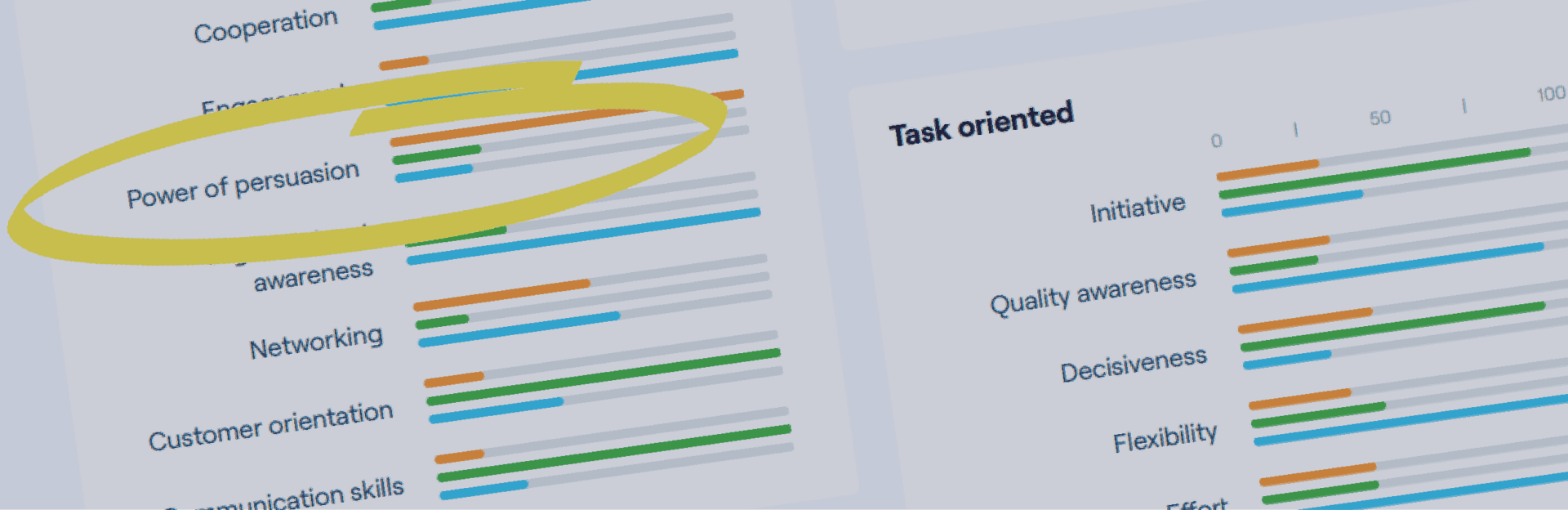
Competency 11: Persuasiveness
Persuasiveness is about more than speaking firmly or having a strong argument. It is the behavioural competency that enables someone to gain support for ideas and proposals by using the right arguments, at the right time and in an appropriate style. It also involves standing up tactfully for one’s own opinions, needs and interests without unnecessarily harming the other person. In situations involving conflicting interests, persuasiveness also relates to negotiation, conflict management, influence and authority.
The key lies in balance. Someone who only transmits a message may be right on substance yet still create little movement. Someone who only adapts may build support but lose their own position. Effective persuasiveness therefore requires both clarity and alignment.
In this article
A recognisable workplace situation
Imagine this: a consultant presents a proposal that is sound in substance. The figures have been checked, the risks have been considered and the arguments are clear. During the meeting, a colleague responds critically. Instead of first exploring where the resistance comes from, the consultant repeats the arguments even more forcefully. The discussion becomes stronger in terms of content, but the distance between the participants grows.
A strong story is not automatically a persuasive one.
This is exactly where persuasiveness is often misunderstood. The question is not only whether your reasoning is sound, but also whether you understand what the other person needs in order to come with you. Sometimes that requires additional evidence. Sometimes recognition of an interest. Sometimes different timing, tone or wording.
What is persuasiveness?
Nieuwenhuis defines persuasiveness as gaining agreement for ideas and proposals by using the right arguments at the right moment and in an appropriate style. This includes assertiveness: standing up for one’s own opinion, needs or interests in a tactful way that does not harm others. Conflict management is also part of the competency, especially when conflicting interests become emotionally charged.
Within this framework, negotiation means achieving goals in consultation with other stakeholders without losing sight of each other’s interests. Authority refers to the natural ability to exert influence and be accepted as an authority. This becomes visible in the ability to command attention, convey expertise and make a self-confident impression.
Persuasiveness connects content, relationships and context to make agreement possible.
Role, skill or behavioural competency?
In organisations, persuasiveness is often confused with presentation skills, charisma or verbal fluency. Yet someone can be an excellent presenter and still struggle with objections, conflicting interests or emotional resistance. Conversely, someone can speak calmly and still have considerable influence because their arguments align well with what others consider important.
Not just presenting
A strong presentation says little about how someone responds to disagreement or resistance.
Not just charisma
Speaking calmly can have considerable influence when arguments align with what matters to the other person.
A behavioural competency
Recurring behaviour shows how someone substantiates ideas, aligns with others, identifies interests and safeguards the relationship.
That is why persuasiveness is primarily a behavioural competency. It becomes visible in recurring patterns: how someone substantiates a position, responds to disagreement, weighs perspectives, identifies interests, handles resistance and uses influence without losing sight of the relationship. For HR, it is therefore more useful to ask what type of persuasive behaviour a role requires than to simply label someone as “persuasive” or “not persuasive”.
Scientific foundation
Scientific research on persuasiveness draws on several domains: persuasion, social influence, negotiation, assertiveness, leadership and employee voice. The Elaboration Likelihood Model by Petty and Cacioppo (1986) shows that the quality of arguments matters when people are motivated and able to think carefully about the content. At the same time, credibility, context and alignment with the recipient also influence how a message is processed.
In a meta-analysis, Lee et al. (2017) found that rational persuasion is positively associated with task and relational outcomes, while consultation, collaboration, inspirational appeals and making benefits visible can also be effective. Pressure, by contrast, was negatively associated with outcomes.
Persuading is not the same as pushing harder.
Perspective taking also plays an important role. Galinsky et al. (2008) showed that negotiators who actively tried to understand what the other person thought and wanted were better able to uncover underlying common ground and create value. This supports the idea that persuasiveness is not only about the strength of one’s own argument, but also about translating it into terms that connect with the other person.
Why this competency has such impact
Persuasiveness matters because much professional work depends on agreement, support and collaboration. Good ideas achieve little if no one understands them, accepts them or helps put them into practice. The competency therefore plays a role in consulting, sales, leadership, project management, change processes, negotiations, team meetings and decision making.
The competency operates within a network
Closely related
Communication skills, courage and self-confidence.
Supporting
Empathy, analytical ability and judgement.
Enabling action
Networking, decisiveness and initiative.
The competency also works in combination with other behavioural competencies. Communication skills, courage and self-confidence are closely related. Empathy, analytical ability and judgement support persuasiveness. Networking, decisiveness and initiative help turn influence into relationships, choices and action.
That interaction is particularly important. Someone may, for example, be strong in empathy but barely use that information in their own arguments. Development then does not mean that an entirely new quality is missing, but that existing qualities need to be connected more consciously.
The three levels of persuasiveness
Nieuwenhuis distinguishes three levels. The operational level focuses on clear and logical argumentation. The tactical level is about putting yourself in the other person’s position and dealing with differences in viewpoints. The strategic level focuses on persuading in situations involving differing interests and on helping others get proposals implemented.
Operational
Arguing clearly and logically.
Tactical
Weighing perspectives and responding to objections.
Strategic
Connecting differing interests and building support.
These levels are not a ladder from poor to good. They describe different types of behaviour. The distribution shows where persuasiveness appears naturally and where more conscious direction is needed.
Each level explained in detail
Operational
At the operational level, persuasiveness means arguing clearly and logically. Someone provides sound reasoning for their own opinion, expresses it clearly, believes in their position and is able to convey that confidence. At the same time, they remain open to the opinions of others.
Key strength
The strength of this level is clarity. The other person knows where you stand and why.
Relevant pitfall
The pitfall arises when persuasion becomes mainly about transmitting a message. Arguments are then repeated or sharpened without sufficiently exploring why the other person is not yet convinced.
Practical example
A practical example: an employee wants to change a way of working. Operationally persuasive behaviour means clearly explaining what problem the current approach causes, what the proposed change solves and why they believe in it. At the same time, they remain open to questions and criticism without immediately giving up their own position.
Tactical
At the tactical level, attention shifts to the other person. Someone argues their own position from multiple perspectives, makes clear what the proposal offers the other person and responds substantively to objections. Their own position remains intact, but the argumentation is adapted to the conversation partner.
Key strength
The strength of tactical persuasiveness lies in shifting perspective. It is not only about: “Why am I right?”, but also: “What makes this relevant, acceptable or valuable to you?”
Relevant pitfall
The pitfall is assuming too quickly that you understand the other person. Genuine alignment requires listening, asking follow-up questions and checking assumptions.
Practical example
A practical example: a project manager wants additional capacity for a project. With finance, she emphasises the risks and costs of delay; with the team, she discusses workload and quality; with senior management, she links the proposal to strategic goals. The proposal remains the same, but the relevant arguments differ.
Strategic
At the strategic level, persuasiveness operates in situations involving differing interests, underlying emotions and greater resistance. Someone recognises and acknowledges those interests and emotions, makes shared interests visible and is able to overcome resistance through preparation, persistence and confidence in their own position. They also help others improve their arguments and choose an appropriate tactic.
Here, persuasiveness shifts from an individual conversation to broader influence. The question is no longer only how to persuade one person, but how to create support among multiple parties. Strategic persuasion therefore also requires a sense of timing, power dynamics, formal and informal influence and the ability to allow dissent.
Key strength
Recognising differing interests and emotions, making shared interests visible and creating broader support.
Relevant pitfall
Influence crosses a professional boundary when it becomes more important than mutual acceptance and room for dissent.
Practical example
A practical example: during a reorganisation, the interests of senior management, employees, HR and employee representation differ. Strategic persuasiveness then does not mean repeating the same argument, but understanding underlying concerns, identifying shared interests and creating a route in which different parties can sufficiently recognise their own interests.
The three levels reinforce one another
The levels are different, but they can complement one another strongly. Operational persuasiveness provides clarity. Tactical persuasiveness ensures that this clarity connects with the other person. Strategic persuasiveness connects differing interests and creates support in more complex situations.
Balance prevents imbalance
When one level dominates, imbalance can arise. Strong operational persuasiveness without tactical alignment can feel pushy. Strong tactical alignment without a clear position of one’s own can lead to adapting without direction. Strategic thinking without concrete argumentation remains abstract.
Effective persuasiveness therefore does not require every level to be equally strong, but it does require someone to recognise what behaviour the situation calls for.
Effective use starts with the right match
The form of persuasiveness required depends on the role and context.
Operational strength
In operational or customer-facing roles, operational persuasiveness is often crucial: explaining clearly, conveying confidence and being able to substantiate a point of view.
Tactical strength
In consulting, project management and account management, tactical behaviour is more important because interests and objections constantly need to be weighed.
Strategic strength
In senior management, leadership, organisational development and complex stakeholder environments, the strategic level becomes increasingly important.
A mismatch can lead to incorrect conclusions. Someone who shows little visible strategic persuasive behaviour is not necessarily “bad at persuading”. Their natural strength may simply lie at a different level from what the role requires. This distinction makes selection and development much more precise.
Why organisations often assess this competency incorrectly
Organisations often assess persuasiveness too quickly based on visible behaviour. A candidate who speaks fluently, makes eye contact and answers without hesitation is easily perceived as persuasive. This mainly says something about the operational impression. It says little about how someone responds to substantive objections, conflicting interests or emotional resistance.
A second misconception is that more persuasiveness is always better. Research by Ames and Flynn (2007) shows that both too little and too much assertiveness can be detrimental to perceived leadership effectiveness. Too little assertiveness can hinder goal achievement; too much can damage relationships and be perceived as dominant.
A third misconception is that the three levels automatically build on one another. This is not necessarily the case. Someone can be very strong at arguing clearly while showing little visible behaviour in shifting perspective or connecting differing interests. That is precisely why persuasiveness should be considered at each level separately.
Visible behaviour is not a reliable overall measure of persuasiveness.
Demand for the competency of persuasiveness is increasing
Demand for persuasiveness is growing because professionals increasingly need to collaborate across roles, teams and organisations. Formal authority is often unavailable, while decisions still depend on support.
61%
In the Future of Jobs Report 2025, 61% of surveyed employers identify leadership and social influence as core skills. Empathy and active listening are also widely regarded as important skills (World Economic Forum, 2025).
Digitalisation, AI, sustainability transitions and continuous organisational change are increasing this need. Strong content alone is increasingly insufficient. Professionals must be able to translate complex information, make resistance discussable and bring different stakeholders along in decisions.
At the same time, this competency is under pressure
The same developments that make persuasiveness more important can also weaken it. High speed and digital communication encourage short messages and rapid decisions, while tactical and strategic persuasiveness require time to explore interests and objections.
AI is also changing the playing field. Technology can help formulate arguments, presentations and proposals more quickly, but it does not replace the relational side of persuasion. Reading resistance, dealing with emotion, judging timing and maintaining credibility remain distinctly human.
There is also a risk of manipulation when influence becomes more important than mutual acceptance. Professional persuasiveness therefore always requires a boundary: the goal is agreement and support, not applying pressure until the other person gives in.
An example: from profile to development direction
In the profile used here, persuasiveness scores 86% operationally, 25% tactically and 22% strategically. The strength clearly lies in arguing clearly, taking a position and conveying confidence in that position. The lower tactical and strategic scores show that aligning with interests, objections and emotions is less naturally visible.
Operational
Tactical
Strategic
The interaction with other scores is what makes this particularly interesting. Tactical empathy is strongly visible, as are strategic analytical ability and tactical networking. The necessary building blocks are therefore present in different areas. The development challenge lies primarily in combining these qualities more consciously in situations involving influence.
This profile illustrates why self-insight makes a difference.
Personality shapes the natural style
Not everyone persuades in the same way. Personality and learning style influence which approach comes naturally and where the development challenge lies. An Achiever often persuades in a goal-oriented and self-confident way, but may need to slow down to truly understand the other person. A Helper connects easily, but may struggle to hold on to their own position. An Enthusiast inspires others, while persistence in the face of resistance may require more discipline. A Perfectionist persuades through care and quality, but may struggle with other valid frames of reference.
An Individualist brings authenticity, but may experience resistance personally. An Observer persuades through knowledge and expertise, but still needs to take the step towards active influence. A Loyalist builds trust, but may begin to doubt under pressure. A Leader conveys authority and directness, while allowing space for the other person requires attention. A Mediator sees multiple perspectives, but needs to keep their own position visible.
Learning styles can guide development
Learning styles also provide a useful framework for reflection.
- The Accommodator learns to persuade through practice and direct feedback.
- The Diverger learns through observation, timing and reflection.
- The Assimilator learns through models and in-depth analysis, with the challenge that their own reasoning can become too dominant.
- The Converger learns through focused application and structuring, but needs to remain alert to relational and emotional objections.
Learning styles are not fixed predictors here, but they can help select development activities that fit the individual.
What this means for organisations
For organisations, this means persuasiveness should not be assessed as one broad label. Recruitment can observe the three levels separately, for example through a short presentation, a critical question-and-answer session and a simulation involving conflicting interests. This reveals whether someone is only strong at putting across a message or can also align and connect.
- Recruitment: observe argumentation, alignment and the ability to connect interests separately.
- HR and managers: focus development on the specific gap, such as perspective taking or dealing with resistance.
- Senior management: actively seek out differing perspectives and leave room to adjust a position.
For HR and managers, this means development can become more specific. An employee with strong operational persuasiveness does not automatically need more presentation training. The development need may instead lie in perspective taking, dealing with resistance or connecting interests. Psychological safety is also important for teams: persuasiveness works better when people are genuinely allowed to disagree.
For senior management, the strategic dimension is particularly relevant. Organisations need leaders who can not only persuade others, but also actively seek out differing perspectives and adjust their own position when better arguments emerge.
How Voice Your Future makes this competency visible
Voice Your Future makes persuasiveness visible by looking not only at the competency as a whole, but at its distribution across operational, tactical and strategic behaviour. This creates a richer picture than a single overall score.
- What comes naturally to someone?
- Where is the friction?
- Which development direction fits the natural style?
The profile helps answer three questions: what comes naturally to someone, where is the friction and which development direction fits their natural style? The relationships between competencies are universal, but the specific expression of persuasiveness is personal.
The essence of persuasiveness
Persuasiveness is the ability to present your own position clearly and credibly while connecting sufficiently with the other person to make agreement possible. Operationally, it is about argumentation and conveying confidence. Tactically, it is about shifting perspective and addressing objections. Strategically, it is about interests, emotions, resistance and broader support.
The strength does not lie in speaking louder, but in choosing more effectively what the situation requires. Sometimes that means firmness. Sometimes listening. Sometimes a different argument, better timing or making a shared interest visible.
When persuasiveness is understood in this way, influence is not about defeating the other person. It is about connecting content, relationships and context so that a good idea can truly resonate.
References
This page is based on scientific literature on persuasion, social influence, negotiation, assertiveness, leadership, employee voice and interpersonal development.
Ames, D. R., & Flynn, F. J. (2007). What breaks a leader: The curvilinear relation between assertiveness and leadership. Journal of Personality and Social Psychology, 92(2), 307-324.
Chartered Institute of Personnel and Development. (2024). Selection methods.
De Dreu, C. K. W., & Weingart, L. R. (2003). Task versus relationship conflict, team performance, and team member satisfaction: A meta-analysis. Journal of Applied Psychology, 88(4), 741-749.
Detert, J. R., & Burris, E. R. (2007). Leadership behavior and employee voice: Is the door really open? Academy of Management Journal, 50(4), 869-884.
Galinsky, A. D., Maddux, W. W., Gilin, D., & White, J. B. (2008). Why it pays to get inside the head of your opponent. Psychological Science, 19(4), 378-384.
Lacerenza, C. N., Reyes, D. L., Marlow, S. L., Joseph, D. L., & Salas, E. (2017). Leadership training design, delivery, and implementation: A meta-analysis. Journal of Applied Psychology, 102(12), 1686-1718.
Lee, S., Han, S., Cheong, M., Kim, S. L., & Yun, S. (2017). How do I get my way? A meta-analytic review of research on influence tactics. The Leadership Quarterly, 28(1), 210-228.
Martin-Raugh, M., Williams, K. M., & Lentini, J. (2020). Developing interpersonal skills: A review of 39 meta-analyses and systematic reviews. ETS Research Report Series.
Nieuwenhuis, M. A. (2010). The art of management: Mensen (Deel 2, 10e herziene druk). Uitgeverij Lulu.
Pashler, H., McDaniel, M., Rohrer, D., & Bjork, R. (2008). Learning styles: Concepts and evidence. Psychological Science in the Public Interest, 9(3), 105-119.
Petty, R. E., & Cacioppo, J. T. (1986). The elaboration likelihood model of persuasion. Advances in Experimental Social Psychology, 19, 123-205.
World Economic Forum. (2025). The Future of Jobs Report 2025.

