Vision
Providing direction when the future is still uncertain.
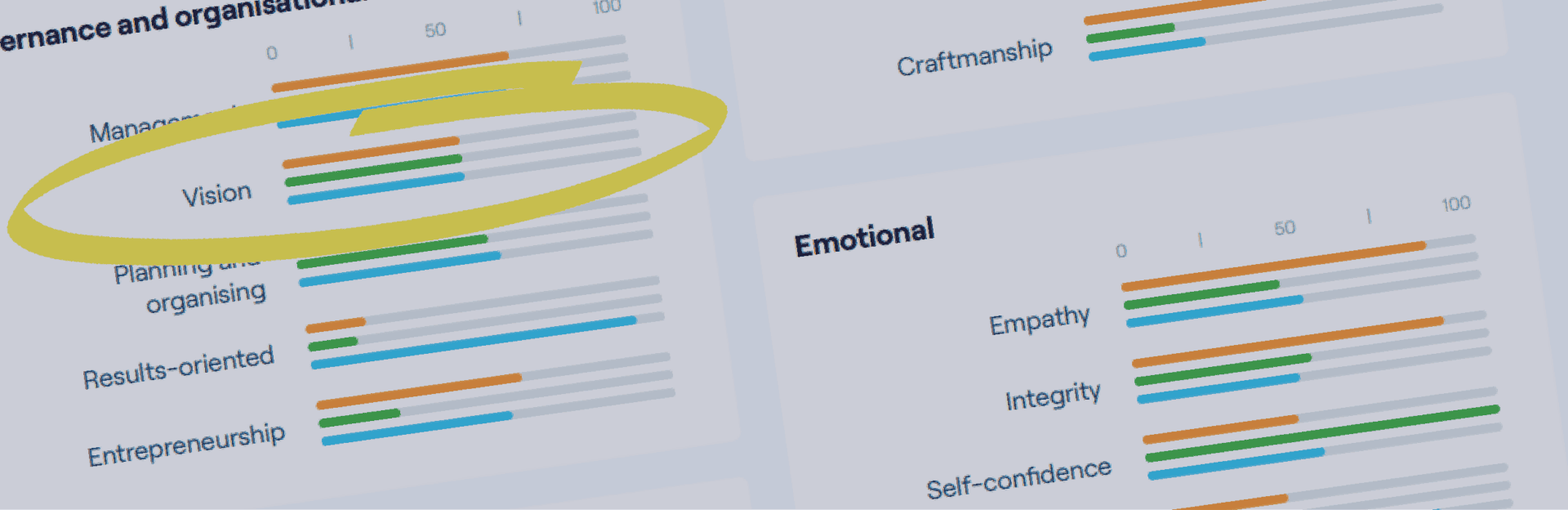
Competency 5: Vision
Vision is the ability to step back from day-to-day practice, place relevant facts and developments in a broader context, and use them to develop and communicate a vision of the future. At the operational level, a person connects the mission and strategy to their own work. At the tactical level, developments are translated into proposals, plans, and behavior. At the strategic level, a person develops their own direction by weighing broader developments and involving others in policy development.
In this article
A recognizable workplace situation
A management team is discussing the direction for the coming year. The market is shifting, AI is changing work processes, and employees are asking for clarity. Yet the conversation remains focused on projects, staffing, and priorities for the next quarter. Each individual decision can be justified, but no one articulates the shared future they are trying to create.
Then someone asks a different question: what do we want to stand for three years from now, and which choices should we therefore make differently today? The conversation shifts. The participants no longer discuss only what is urgent, but also which developments they expect, which position they want to take, and which activities no longer fit that direction.
This is where vision becomes visible. Not in grand statements or an inspiring presentation, but in the ability to step back from day-to-day practice, connect meaningful developments, and formulate a vision of the future that guides action. A vision does not provide certainty about what will happen. It clarifies what an organization wants to prepare for and which choices it is willing to make under uncertainty.
What is vision?
Nieuwenhuis defines vision as developing and communicating a vision of the future. This involves stepping back from day-to-day practice, recognizing facts, trends, and future developments, and placing them in a broader context and long-term perspective within one’s own field of work, professional domain, or organizational unit. He lists imagination, communicating a vision, developing a vision, and taking a helicopter view as related concepts. In his framework, vision belongs to the managerial and organizational competencies (Nieuwenhuis, 2010).
This definition contains four connected movements. First, a person creates enough distance not to be driven entirely by what is happening right now. Next, relevant facts and developments are selected. These signals are then interpreted within a broader context. Finally, a vision of the future emerges that is articulated and connected to choices. Simply collecting trends is not yet vision. Neither is presenting an appealing story about the future without facts, context, or consequences.
Vision also differs from prediction. A prediction states what is likely to happen. A vision describes which future is desirable or guiding and how a person or organization wants to position itself in relation to that future. Scenarios can explore different possible developments; strategy determines how resources and activities are deployed; goals make desired results concrete. Vision defines the larger picture of the future that connects those scenarios, strategy, and goals.
Vision is therefore cognitive, normative, and social at the same time. Cognitive, because information must be interpreted and placed in context. Normative, because choosing a direction also means deciding what is important and desirable. Social, because a vision only gains organizational meaning when others can understand it, test it, influence it, and translate it into behavior.
Role, skill, or behavioral competency?
Not just a role
Vision is often associated with executive leadership, strategy, entrepreneurship, or governance. That is understandable, but too limited. A role may require a great deal of vision, but a job title does not prove that someone demonstrates vision-related behavior. Professionals without a formal strategic mandate can also recognize relevant developments, challenge existing ways of working, and connect their own work to a broader vision of the future.
Not a single standalone skill
Vision is not a single standalone skill either. Analytical ability helps examine facts and patterns. Creativity helps imagine alternatives. Environmental awareness brings external developments into the organization. Judgment helps substantiate choices. Communication skills and persuasiveness make a vision of the future discussable. Planning and organizing, decisiveness, initiative, and results orientation are needed to turn direction into action. None of these skills on its own constitutes the competency of vision.
It is a behavioral competency
As a behavioral competency, vision becomes visible through a recurring combination of knowledge, attitude, skills, and behavior. A person steps back from day-to-day pressure, examines developments, connects the short and long term, formulates a direction, discusses the consequences, and remains willing to revise the vision when underlying assumptions are no longer tenable. For HR and recruitment, the relevant question is therefore not whether a candidate appears “visionary,” but which future-oriented behaviors the role requires and in which specific situations those behaviors were demonstrably visible.
Scientific foundation
Vision is not a uniform psychological construct with one generally accepted measurement scale. Its functioning is explained through several research traditions, including future-oriented cognition, goals, leadership, meaningful work, learning, and organizational change. This combination aligns well with Nieuwenhuis’ definition of the competency, which brings together observation, stepping back, developing direction, and communicating that direction.
Van der Helm (2009) describes visions of the future as images that connect perception, values, and possible courses of action. In this view, a vision is not a neutral description of what comes later, but a way to interpret the present and open up possibilities for action. This helps explain why the same development can lead to different visions: facts place boundaries around what is plausible, while values and choices determine which direction a person considers desirable.
Research on prospection, the human ability to imagine possible futures, helps explain why thinking about the future can guide practical behavior. Baumeister, Vohs, and Oettingen (2016) describe how people use future situations to form goals, anticipate obstacles, and organize present behavior. Future thinking is therefore not imagination without consequence. It becomes functional when it affects attention, preparation, and choice.
Goal-setting theory by Locke and Latham (2006) helps explain the translation from direction into execution. Specific and challenging goals can support performance when people are committed to them, receive feedback, and have sufficient opportunities and resources. This research does not directly prove that a vision is effective. It does, however, show why a vision of the future without concrete goals has little power to shape behavior. Vision provides meaning and direction; goals make the required progress visible.
In leadership research, vision appears most prominently in transformational and visionary leadership. The meta-analysis by Judge and Piccolo (2004) found positive associations between transformational leadership and factors including leadership effectiveness, follower satisfaction, and motivation. This does not mean that every inspiring story causes these effects. Transformational leadership encompasses more than vision, and these associations are averages across a wide range of contexts. Research by Liu et al. (2022) also suggests that visionary leadership can support employees in taking initiative when psychological mechanisms and the context make that possible. The relevant lesson is that vision only gains impact through credibility, identification, room to act, and concrete behavior.
Psychological safety is an important condition for testing a vision. Edmondson (1999) showed that teams learn more effectively when people feel able to discuss questions, mistakes, and concerns. Detert and Edmondson (2011) described implicit beliefs that can prevent employees from speaking up even when there is no explicit prohibition. An organization may therefore contain a great deal of strategic thinking that remains invisible. Vision requires not only someone who formulates direction, but also a climate in which assumptions, objections, and alternatives are genuinely allowed to influence that direction.
Vision can affect well-being at work and engagement through meaning, but caution is needed here as well. Frémeaux and Pavageau (2022) describe how leaders can contribute to meaningful work through values, community, support, and moral role modeling. A credible vision can connect day-to-day work to a larger purpose. A vision that is inconsistent with decisions, workload, or reward systems can instead create cynicism. What matters is not simply whether a vision exists, but whether people experience consistency between words, values, and actions.
Personal development also has a future-oriented component. Reviews by Kooij and colleagues show that future time perspective is associated with motivation, career choices, and adaptation in the work context (Kooij & Van De Voorde, 2017; Kooij et al., 2018). People differ in how many future possibilities they perceive and which goals therefore become meaningful. Developing vision is not only about learning to analyze or present. It also involves exploring which future a person sees, which assumptions underlie that view, and which behaviors are needed to take responsibility for it today.
Why this competency has so much impact
Vision organizes complexity, creates meaning, and enables selection. Organizations constantly receive new information about technology, the labor market, customers, legislation, and societal expectations. Without direction, every new signal can become a new priority. A vision provides a criterion: which development affects the future we are trying to create, and which does not?
This selective function has direct implications for effectiveness. Strategy, innovation, and people policies compete for the same time, people, and resources. A clear vision of the future helps connect decisions and prevents departments from optimizing in isolation without a shared direction. It also makes it possible to stop activities. What once made sense may lose its relevance when the desired future changes.
Vision also provides meaning. Employees understand not only what is expected of them, but also why change is needed and how their contribution fits into it. This can support motivation and engagement, provided the vision is credible and the organization makes it visible in its choices. Meaning without feasibility leads to disappointment; feasibility without meaning can easily result in compliance without ownership.
The competency operates within a network
Build the content
Analytical ability, environmental awareness, judgment, and creativity shape the content of a vision.
Make it credible
Organizational awareness, communication skills, persuasiveness, courage, and integrity influence whether the vision becomes discussable, credible, and workable within the organization.
Turn direction into action
Planning and organizing, decisiveness, initiative, results orientation, leadership, and entrepreneurship turn direction into execution.
This interconnection is widely recognizable. The specific combination differs by person, role, and context.
Vision also carries risks. A strong direction can focus attention, but it can also push contradictory evidence out of view. Charisma can conceal uncertainty. An inspiring story can overshadow competing interests or implementation problems. Consistency of direction can gradually turn into rigidity. Mature vision therefore combines direction with testability: clear assumptions, room for dissenting information, and predetermined moments at which the direction is reassessed.
The three levels of vision
Nieuwenhuis distinguishes three levels: looking ahead, translating developments into policy proposals, and developing and communicating a vision of the future.
Operational
Operational signals keep vision connected to day-to-day work.
Tactical
Tactical translation makes direction actionable.
Strategic
Strategic vision connects developments and values to longer-term policy choices.
The levels are not a ranking from weak to strong. They describe different functions within one process.
Each level explained in detail
Operational
According to Nieuwenhuis, operational vision means knowing the mission and strategy of one’s own organizational unit, contributing to discussions about them, and connecting that strategy to one’s own activities. This level remains close to day-to-day work but looks beyond the individual task. Typical behavior includes asking how an activity contributes to the direction, signaling when a way of working no longer fits that direction, and using practical experience to contribute to conversations about the future of the unit.
Key strength
The key strength is a strong sense of reality. Operational vision makes visible what an abstract vision of the future means for processes, customer contact, and professional practice. Employees close to execution are often among the first to notice where policy conflicts with changing needs or where new possibilities are emerging.
Relevant pitfall
The pitfall is that this behavior may not be recognized as vision, or that a person limits themselves to the existing direction. Knowing the mission and strategy is not the same as critically examining whether they remain viable. Conversely, every practical problem can too quickly be presented as a strategic signal.
Practical example
For example, a recruiter notices that candidates are increasingly asking about internal mobility and working with AI. She compares these questions with the labor market strategy and discusses whether the current employer value proposition still fits. The vision-related behavior does not lie in predicting the entire labor market, but in connecting recurring signals from practice to the chosen direction.
Tactical
Tactical vision means contributing to the development of the vision for one’s own organizational unit in alignment with the organization’s broader vision. Nieuwenhuis also includes communicating the vision internally and externally, translating trends in the professional field into possibilities, and developing concrete proposals with attention to medium-term effects.
Key strength
The key strength is translation. Tactical vision connects the vision of the future to policy, priorities, collaboration, and resources. It prevents strategy from remaining a separate story and teams from acting only from their own short-term perspective.
Relevant pitfall
The pitfall is that someone may be excellent at translating another person’s direction without developing their own substantive judgment. Another pitfall is false concreteness: many projects may be launched without clarifying which assumption is being tested or which vision of the future they are intended to bring closer.
Practical example
A team manager is asked to make the team more customer focused. Instead of treating this as a standalone training program, she connects the direction to work processes, role clarity, feedback, customer data, and measurable behavioral goals. At the same time, she identifies the implications of the chosen direction for capacity and collaboration with other departments.
Strategic
According to Nieuwenhuis, strategic vision means taking the initiative in strategic policy development. A person weighs legal, political, and societal developments, translates them into strategic choices and actions for the organization, and encourages others to contribute to policy development. This level therefore requires both an independent vision of the future and the ability to organize collective thinking.
Key strength
The key strength is providing direction under uncertainty. Strategic vision connects developments that have not yet fully crystallized to a well-founded position. This creates time to develop options before change can only be addressed reactively.
Relevant pitfall
The pitfall is becoming disconnected from execution or projecting too much certainty. A vision is not a prediction. Participation can also become symbolic when others are invited to contribute but their information cannot genuinely influence the direction. The opposite risk is that constant consensus building causes the vision to lose its sharpness.
Practical example
An executive team concludes that AI is not only accelerating processes, but also changing roles, customer expectations, and the competencies required. It therefore does not simply choose a tool, but formulates principles for human oversight, learning, job design, and value creation. HR, employees, customers, and experts contribute information. The executive team remains responsible for the final direction and explicitly identifies which assumptions will be retested later.
The three levels reinforce one another
Operational vision provides concrete signals and tests whether the direction is recognizable in day-to-day work. Tactical vision translates direction into plans, priorities, and collaboration. Strategic vision determines which future the organization is pursuing and which broader developments are relevant to it.
When one level is missing
When one level is missing, imbalance develops. Strategy without operational observation can become elegant but unrealistic. Operational sharpness without a strategic perspective may identify many signals but offers no criterion for selection. Tactical strength without an independent direction can lead to efficient execution of a course that is no longer appropriate. Conversely, a strong strategic voice without tactical translation remains dependent on isolated initiatives.
Mature vision therefore does not mean thinking permanently at the highest level of abstraction. It means being able to move between a vision of the future, policy translation, and day-to-day reality, with feedback flowing in both directions.
Effective use starts with the right match
Not every role requires the same form of vision.
Operational strength
In roles close to customers, technology, or execution, the value often lies in operational foresight: understanding the direction, connecting practical information to it, and identifying emerging tensions early.
Tactical strength
In project leadership, HR, consulting, and middle management, tactical vision is often more important because direction must be translated into plans, stakeholder interests, and behavior.
Strategic strength
Executive, innovation, and policy roles more often require strategic vision because they involve choices across longer time horizons and broader developments.
A high strategic score is therefore not automatically better than an operational or tactical score. The relevant question is which behavior is needed, how much decision-making latitude the role provides, and what consequences a judgment about the future may have. An organization that seeks maximum strategic vision in every management role may select people who enjoy setting direction but are less strong in translation or execution.
Personal future perspective also plays a role. A person may see many possibilities but experience little mandate, or may be responsible for strategy without sufficient access to signals from practice. Effective use therefore requires alignment between the person, the role, and the decision-making environment. Vision is shaped not only by what someone can do, but also by the information, safety, time, and influence made available by the context.
Why organizations often misjudge this competency
Organizations often confuse vision with charisma, abstract language, seniority, or persuasiveness.
Someone who speaks confidently about the future can easily appear visionary. Yet a convincing story may be based on selective information, borrowed language, or assumptions that have never been tested. Conversely, a person may demonstrate vision through a sharp question, a well-supported scenario, or consistent policy translation without highly visible presentation behavior.
A second assessment error is treating only strategic behavior as vision. This leaves operational and tactical forms out of view. The professional who connects developments in practice to the direction at an early stage and the manager who makes an abstract future vision executable both contribute essential vision-related behavior.
A third error is using the outcome in hindsight as evidence. A successful result may partly be due to chance; a well-founded vision may turn out differently because of unexpected events. The process should therefore be assessed as well: which facts and trends were used, which alternatives were considered, which values shaped the direction, which consequences were identified, and what information would prompt an adjustment?
In selection, a concrete case works better than asking where someone sees themselves in five years. Candidates can, for example, choose a development in their field and explain what it could mean at the operational, tactical, and strategic levels. Then ask which assumptions are uncertain, whom they would involve, and which first choice they would make now. This makes it visible whether someone is merely telling an appealing story or can genuinely develop and translate direction.
Why vision is especially relevant today
Vision is especially relevant because organizations are dealing simultaneously with technological, demographic, geopolitical, and social change. The World Economic Forum (2025) reports that employers expect 39% of current core skills to change by 2030. Analytical thinking, leadership and social influence, creative thinking, and systems thinking remain important building blocks. These figures do not measure vision directly, but they do describe a labor market in which current task proficiency alone is becoming less sufficient for assessing future contribution.
Cedefop uses skills forecasting and foresight to explore possible developments in work and learning. The publication Preparing for 2040 uses alternative scenarios for continuing skills development and the influence of AI. Such scenarios are not predictions. They help make visible which assumptions, risks, and policy choices belong to different futures (Cedefop, 2025). ESCO supports this at another level by providing a European language for transversal skills and competencies (European Commission, n.d.). For HR, the focus therefore shifts from current job fit alone to the combination of employability, learning capacity, and direction in changing work.
Organizations themselves are also under pressure to move faster. In the 2026 Global Human Capital Trends, Deloitte reports that seven in ten surveyed leaders identify speed and agility as a primary competitive strategy for the coming years. At the same time, speed and continuous adaptation without vision can lead to fragmentation. Vision clarifies what an organization is adapting to and which value it wants to preserve in the process (Deloitte, 2026).
The need for direction exists alongside low engagement. Gallup reports that 20% of employees worldwide were engaged at work in 2025. This figure does not prove a lack of vision, but it does illustrate the context in which organizations must make their future story credible. A vision that is not recognizable in leadership, job design, and decision-making is unlikely to build much credibility (Gallup, 2026).
Microsoft provides an illustrative example, although one described by the company itself. Under Satya Nadella, the direction was linked to a shift from internal competition toward learning, collaboration, and a growth mindset. The value of the case does not lie in copying that language, but in the connection between a strategic vision of the future, leadership behavior, and organizational practices. The vision became useful because it had consequences for collaboration, technology, and culture (Microsoft Inside Track, 2026).
At the same time, vision is under pressure from short accountability cycles, dashboards, and rapid technology adoption. When every quarter must show immediate results, long-term questions are easily postponed. AI can accelerate scenarios and analyses, but it does not make the normative choice: which future does the organization want to help create, which interests should be considered, and which boundaries apply? Precisely because information becomes available faster, it becomes more important to distinguish observation, interpretation, and desired direction from one another.
An example: from profile to development direction
First measurement
50% operational | 100% tactical | 0% strategic
Later measurement
50% operational | 50% tactical | 50% strategic
These percentages describe visible behavior across two measurement periods. They do not prove a fixed disposition and, on their own, do not explain what caused the change.
The first pattern supports the hypothesis that translating, coordinating, and aligning were strongly visible. The tactical layer was dominant: direction was converted into plans and connection, while independently initiating and communicating strategic policy direction was not visible. Possible explanations include the role at the time, limited opportunity, hesitation after earlier experiences, or a natural preference for building support. These explanations need to be tested against specific situations.
The later pattern shows that strategic vision-related behavior became more visible and the tactical emphasis decreased. This may indicate a greater willingness to formulate an independent direction, but it may also reflect a different work environment or measurement period. The development question is not simply how the strategic score can increase further. More interesting is whether the three levels now genuinely support one another: are operational signals being used, is the direction translated tactically, and does the vision remain recognizable when others exert influence?
The shift from the Dreamer learning style to the Decider learning style provides a framework for reflection. A Dreamer processes information broadly, sees different perspectives, and may wait a long time before a vision feels mature enough to express. A Decider wants to test direction more quickly and turn it into action, but may skip the tactical layer of alignment. This does not explain the scores. Research does not support the claim that people learn exclusively or demonstrably better when an approach is matched to one learning style (Clinton-Lisell & Litzinger, 2024). Here, the learning style mainly helps formulate focused questions.
The Mediator personality pattern adds a similar nuance. A natural strength may lie in connecting perspectives and formulating a direction in which people can recognize themselves. Tension arises when clear choices disrupt harmony. Vision then asks for something that comes naturally, bringing different voices together, as well as something that may go against the natural tendency: defining and holding an independent course even when not everyone identifies with it.
A suitable development exercise is a short vision brief focused on one real issue. First describe the relevant facts and developments, then three possible future scenarios, followed by the desired direction and the values behind it. Translate that direction into one operational, one tactical, and one strategic choice. Finally, note which counterevidence or development would lead to revision. This combines imagination, substantiation, communication, and adjustment in a single exercise.
What this means for organizations
For recruitment, vision begins with role analysis. Determine which level is genuinely required, which time horizon the person needs to consider, and which developments are relevant. An operational professional does not need to formulate an organization-wide vision of the future. An executive who is mainly able to translate someone else’s direction may not meet the requirements of a role that calls for independent strategic policy development. Structured questions and comparable cases help prevent charisma or job title from dominating the assessment.
For HR, vision means that talent development should not be designed solely around current performance. Strategic workforce planning, succession planning, and internal mobility require a view of future work and the competencies that will be needed. A CIPD case on Unilever describes how the HR direction around people, place, and performance was connected to talent, workplace, and performance. As an organizational case, it illustrates how vision only gains meaning when it influences concrete HR practices; the case is not independent evidence of effectiveness (Chartered Institute of Personnel and Development, 2016).
For team managers, vision is a translation task. They need to connect the organization’s direction to priorities, roles, and behavior, while also carrying signals from the team back upward. This requires psychological safety: employees must be able to point out where the direction does not fit customers, processes, or professional values. Agreement is not a reliable measure of support or quality.
For executive teams, vision is also a governance issue. Make clear who provides information, who challenges assumptions, who decides, and when the direction will be reviewed. Do not reward only short-term results when long-term behavior is being asked for. An organization that demands innovation but punishes mistakes, or asks for ownership while discouraging dissenting views, undermines its own vision of the future.
Career coaching can make vision personal without reducing it to ambition. Relevant questions include: which future in the field does someone find meaningful, what role do they want to play in it, which behaviors are already visible, and what still requires conscious development? In this way, vision connects self-insight to direction for action without pretending that a career can be fully predicted.
How Voice Your Future makes vision visible
Voice Your Future makes vision visible through the separate distribution of operational, tactical, and strategic behavior. This does not produce a general label such as “visionary” or “not visionary,” but a more precise picture of where future-oriented behavior emerged during a particular period.
Its meaning emerges in combination with other competencies. Analytical ability, creativity, and environmental awareness help explain how information and possibilities are formed. Judgment shows how alternatives are weighed. Organizational awareness, persuasiveness, communication, courage, and integrity provide clues about the social and governance dimensions. Planning and organizing, initiative, decisiveness, and results orientation show how direction can be turned into action.
Learning style and personality patterns do not explain or predict the score. They help explore what comes naturally, where tension arises, and which type of practice may be useful. The relationships between competencies are broadly recognizable; the specific combination and development direction are personal.
A score therefore only gains meaning when it is connected to role, context, visible behavior, and impact.
- Where does someone naturally step back from immediate events?
- Where does an independent vision of the future emerge?
- Where does that vision become shareable with others?
- Where does the translation into choices break down?
The essence of vision
Vision is the ability to step back from day-to-day practice, place relevant facts and developments in a broader context, and use them to develop and communicate a vision of the future. At the operational level, a person connects the mission and strategy to their own work. At the tactical level, developments are translated into proposals, plans, and behavior. At the strategic level, a person develops their own direction by weighing broader developments and involving others in policy development.
A strong vision does three things at the same time: it creates meaning, sets boundaries for choices, and remains open to testing. Without meaning, direction becomes a planning exercise. Without choices, it remains a wish. Without testing, consistency of direction can easily become blindness.
The essence is not knowing the future with certainty. It is about providing direction responsibly while that certainty is absent, and acting today in ways that credibly bring the desired future closer.
References
Baumeister, R. F., Vohs, K. D., & Oettingen, G. (2016). Pragmatic prospection: How and why people think about the future. Review of General Psychology, 20(1), 3-16. https://doi.org/10.1037/gpr0000060
Cedefop. (2025). Preparing for 2040: Four AI-powered scenarios for the future of continuing skills development. Publications Office of the European Union. https://doi.org/10.2801/2114554
Chartered Institute of Personnel and Development. (2016). Valuing your talent: Unilever. https://www.cipd.org/en/knowledge/case-studies/value-talent-unilever/
Clinton-Lisell, V., & Litzinger, C. (2024). Is it really a neuromyth? A meta-analysis of the learning styles matching hypothesis. Frontiers in Psychology, 15, Article 1428732. https://doi.org/10.3389/fpsyg.2024.1428732
Deloitte. (2026). 2026 Global Human Capital Trends. https://www.deloitte.com/global/en/insights/topics/talent/human-capital-trends.html
Detert, J. R., & Edmondson, A. C. (2011). Implicit voice theories: Taken-for-granted rules of self-censorship at work. Academy of Management Journal, 54(3), 461-488. https://doi.org/10.5465/amj.2011.61967925
Edmondson, A. C. (1999). Psychological safety and learning behavior in work teams. Administrative Science Quarterly, 44(2), 350-383. https://doi.org/10.2307/2666999
European Commission. (n.d.). Transversal knowledge, skills and competences. ESCO. https://esco.ec.europa.eu/en/about-esco/escopedia/escopedia/transversal-knowledge-skills-and-competences
Frémeaux, S., & Pavageau, B. (2022). Meaningful leadership: How can leaders contribute to meaningful work? Journal of Management Inquiry, 31(1), 54-66. https://doi.org/10.1177/1056492619897126
Gallup. (2026). State of the Global Workplace 2026. https://www.gallup.com/workplace/697904/state-of-the-global-workplace-global-data.aspx
Judge, T. A., & Piccolo, R. F. (2004). Transformational and transactional leadership: A meta-analytic test of their relative validity. Journal of Applied Psychology, 89(5), 755-768. https://doi.org/10.1037/0021-9010.89.5.755
Kooij, D. T. A. M., & Van De Voorde, K. (2017). Future time perspective in the work context: A systematic review of quantitative studies. Frontiers in Psychology, 8, Article 413. https://doi.org/10.3389/fpsyg.2017.00413
Kooij, D. T. A. M., Kanfer, R., Betts, M., & Rudolph, C. W. (2018). Future time perspective: A systematic review and meta-analysis. Journal of Applied Psychology, 103(8), 867-893. https://doi.org/10.1037/apl0000306
Liu, M., Zhang, P., Zhu, Y., & Li, Y. (2022). How and when does visionary leadership promote followers’ taking charge? The roles of inclusion of leader in self and future orientation. Psychology Research and Behavior Management, 15, 1917-1929. https://doi.org/10.2147/PRBM.S366939
Locke, E. A., & Latham, G. P. (2006). New directions in goal-setting theory. Current Directions in Psychological Science, 15(5), 265-268. https://doi.org/10.1111/j.1467-8721.2006.00449.x
Microsoft Inside Track. (2026). Digitally transforming Microsoft: Our IT journey. https://www.microsoft.com/insidetrack/blog/digitally-transforming-microsoft-our-it-journey/
Nieuwenhuis, M. A. (2010). The art of management 1: Strategie en structuur (10th ed.). M. Nieuwenhuis.
Van der Helm, R. (2009). The vision phenomenon: Towards a theoretical underpinning of visions of the future and the process of envisioning. Futures, 41(2), 96-104. https://doi.org/10.1016/j.futures.2008.07.036
World Economic Forum. (2025). The Future of Jobs Report 2025. https://www.weforum.org/publications/the-future-of-jobs-report-2025/

